Securonix Threat Labs Monthly Intelligence Insights – December 2025
Threat Research



Authors: Dheeraj Kumar and Nitish Singh
The Monthly Intelligence Insights report provides a summary of top threats curated, monitored, and analyzed by Securonix Threat Labs in December 2025. The report also includes a synopsis of the threats, indicators of compromise (IoCs), tactics, techniques, and procedures (TTPs), and related tags. Each threat has a comprehensive summary from Threat Labs and search queries from the Threat Research team. For additional information on Threat Labs and related search queries used via Autonomous Threat Sweeper to detect the below-mentioned threats, refer to our Threat Labs home page.
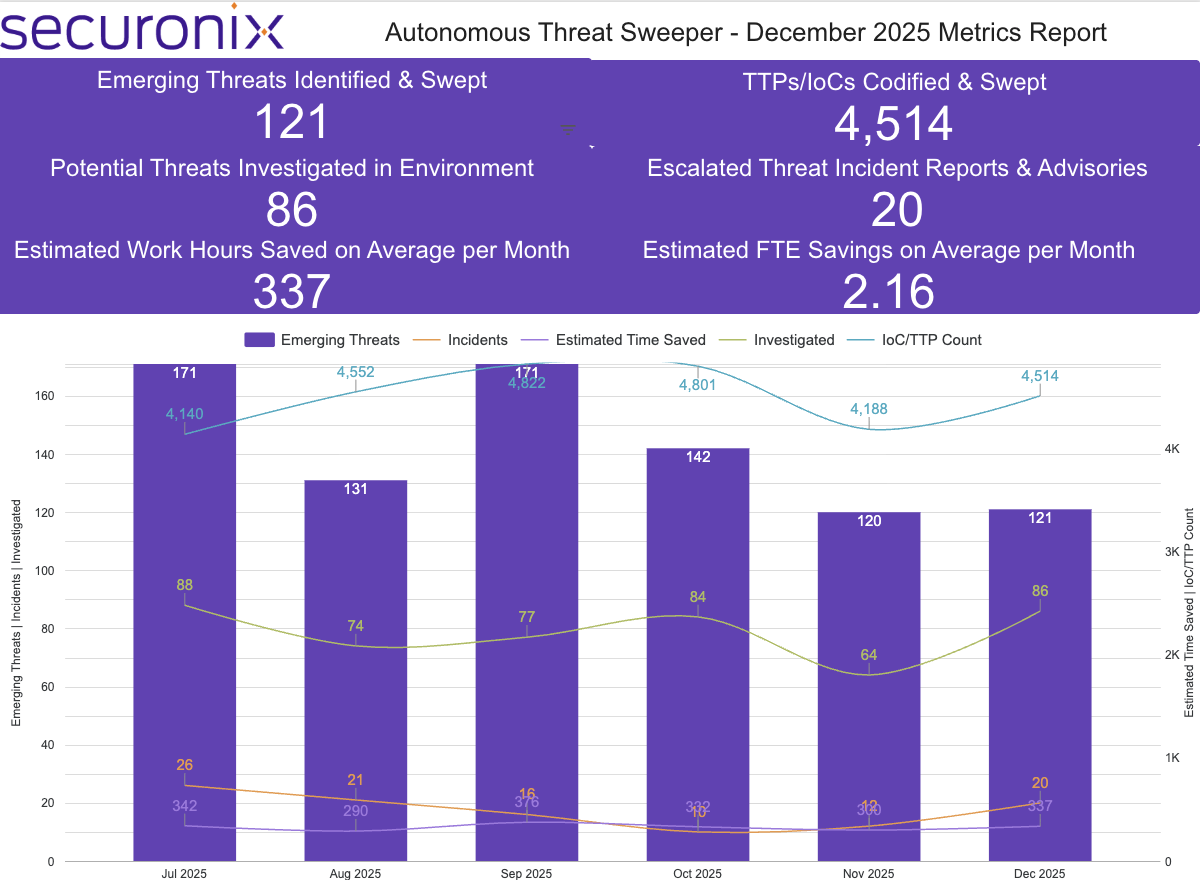
Last month, Securonix Autonomous Threat Sweeper identified and analyzed 4,514 TTPs and IoCs; identified 121 emerging threats; investigated 86 potential threats; and elevated 20 incidents. The top data sources swept against include IDS / IPS / UTM / Threat Detection, Data Loss Prevention, Endpoint Management Systems, and Email / Email Security.
In December 2025, the Autonomous Threat Sweeper team observed an acceleration in exploitation-led intrusions and refined ransomware access chains, driven by rapid weaponization of developer frameworks, trusted tooling, and stealthy delivery mechanisms. Widespread React2Shell activity dominated the month, with multiple campaigns exploiting React Server Component remote code execution flaws, including in-the-wild abuse of React4Shell Redux (CVE-2025-55182), enabling direct server-side compromise through vulnerable React components and sustaining ongoing exploitation of the RSC attack surface. At the same time, adversaries sharpened their post-exploitation and monetization tradecraft, with Storm-0249 shifting toward precision targeting, GOLD SALEM expanding Warlock ransomware operations, and Matanbuchus 3.0 reestablishing itself as a dependable loader within ransomware access pipelines. Malware delivery increasingly abused trusted ecosystems, including ShadyPanda sleeper spyware and GhostPoster malware hidden inside browser extensions, AutoIT3 loaders deploying shellcode via FileInstall abuse, and the emergence of SantaStealer as a new infostealer focused on credential and session theft, while Intellexa-linked actors continued to demonstrate the persistence of zero-day exploitation frameworks. Advanced threat activity remained elevated, with Tomiris APT conducting espionage operations, the Prince of Persia APT resuming targeting, and UAT-9686 exploiting Cisco AsyncOS infrastructure, collectively reinforcing how attackers are converging framework-level RCE, trusted-platform abuse, and streamlined ransomware access chains to enable faster, stealthier, and more targeted intrusions.
This month saw widespread and active exploitation of CVE-2025-55182 (React2Shell), a critical pre-authentication remote code execution vulnerability affecting React Server Components (RSC) used by React, Next.js, and related frameworks. The vulnerability originates from unsafe deserialization in the React Flight protocol, where attacker-controlled objects are insufficiently validated during request reconstruction. By abusing prototype chain traversal, promise resolution (then), and the Blob handler mechanism ($B), attackers can reach the JavaScript Function constructor and execute arbitrary code in the Node.js runtime using a single crafted HTTP request, without authentication and under default configurations.
In-the-wild activity shows that exploitation began almost immediately after public disclosure and rapidly escalated from proof-of-concept testing to full post-exploitation operations. Multiple campaigns were observed deploying cryptominers (such as XMRig), botnets, and advanced post-exploitation frameworks, including interactive command-and-control implants. Both Linux and Windows environments were targeted, with significant focus on containerized and cloud-native workloads. Attackers actively harvest credentials by querying cloud instance metadata services (AWS, Azure, GCP), scanning filesystems for secrets, and abusing developers and CI/CD artifacts. Persistence mechanisms included fileless Node.js backdoors, systemd and cron job installation, and the use of covert network tunnels for command-and-control traffic.
Mitigation guidance indicates that while upgrading to patched versions of affected frameworks addresses the root cause, patching alone is insufficient. Organizations should prioritize remediation of internet-facing assets, deploy web application firewall rules capable of detecting React Flight protocol abuse, monitor Node.js processes for anomalous command execution or in-memory manipulation, and review historical logs for indicators of compromise. Overall, React2Shell represents a high-impact, low-effort attack vector that has already matured into large-scale active exploitation and remains a significant risk to modern web application environments.
Securonix Threat Labs recommends leveraging our findings to deploy defensive measures against these React2Shell flaws.
TTPs related to the React2Shell: Critical RCE Exploitation include but are not limited to the following:
Tags: Threat Name: React2Shell | CVE ID: CVE-2025-55182 | Threat Type: Remote Code Execution (RCE) | Attack Vector: Pre-authentication, single HTTP request | Vulnerability Class: Unsafe Deserialization / Prototype Chain Abuse | Target Sector: Cloud Service Providers, Technology & SaaS, E-commerce, Web Hosting Platforms, Software Development / CI-CD Environments | Target Location: Global | Target Systems: Linux Servers, Windows Servers, Cloud Virtual Machines, Kubernetes Nodes, Containerized Application Hosts | Target Platforms: React Server Components (RSC), Next.js Applications, Node.js Runtime, Cloud-native Platforms (AWS, Azure, GCP), Kubernetes & Container Platforms
| UAT-9686 Targets Cisco Secure Email Gateway | A China-linked threat group tracked as UAT-9686 is conducting an active campaign targeting Cisco AsyncOS software used by Cisco Secure Email Gateway and Secure Email and Web Manager appliances. The group’s objective is to establish persistent, covert access to email security infrastructure that operates at network perimeters and responsible for handling sensitive communications. After gaining initial access, the attackers deploy a custom Python-based backdoor, AquaShell, which provides system-level command execution, along with additional tooling to enable traffic tunneling and manipulate logs in order to evade detection. The activity primarily affects organizations operating these appliances with non-standard configurations, and the impact is significant, as compromise of these systems can expose email traffic and provide a privileged foothold for lateral movement within the network. |
| Prince of Persia cyber-espionage Operation | The Iranian state-aligned threat group known as Prince of Persia (also tracked as Infy) has been conducting long-running cyber-espionage campaigns since at least 2017. The group primarily targets Iranian dissidents, journalists, and organizations associated with critical infrastructure across Iran, Europe, and the Middle East. Its operations rely on custom malware families, notably Foude and Tonnerre, which are commonly delivered through weaponized Excel documents containing malicious macros. Once executed, the malware establishes communication with attacker-controlled servers, fingerprints on the infected host, and enables the staged deployment of additional payloads or updates. The tooling incorporates advanced domain generation techniques, encrypted data exfiltration, and a recent shift toward using the Telegram API for C2 communications. Overall, the activity demonstrates strong operational discipline, supported by resilient infrastructure, multiple active control nodes, and interconnected loaders designed to systematically exfiltrate sensitive victim data. |
| Tomiris cyber-espionage operation | The Tomiris APT group has intensified its cyber espionage activities since early 2025, with a primary focus on government institutions, including foreign ministries, intergovernmental bodies, and other state-linked organizations. The campaign typically starts with phishing emails carrying password-protected archives that lure recipients to open malicious files posing as legitimate Office documents. After initial access, the group deploys additional payloads written in multiple programming languages to establish backdoors and ensure long-term persistence. To conceal command-and-control communications, Tomiris commonly exploits popular platforms such as Telegram and Discord, allowing malicious traffic to blend in with normal network activity. The operators then introduce further tools to support data exfiltration, lateral movement, and traffic tunneling, often leveraging modified open-source components to complicate attribution. Targeting patterns show a clear emphasis on Russian-speaking entities, particularly across Russia and Central Asia. |
Securonix Threat Labs recommends leveraging our findings to deploy defensive measures against these APT group’s activities.
TTPs related to the UAT-9686 Targets Cisco Secure Email Gateway include but are not limited to the following:
TTPs related to the Prince of Persia Cyber-Espionage Operation include but are not limited to the following:
TTPs related to the Tomiris Cyber-Espionage Operation include but are not limited to the following:
Tags: Malware: Foude and Tonnerre | Threat Actor: Prince of Persia, UAT-9686, Tomiris| Target Sector: Government, intergovernmental organizations, Foreign Minitries | Target Location: Middle East, Europe, Iran, Russia, Kyrgyzstan, Tajikistan, Uzbekistan | Target Platforms: Window Endpoints, MS Excel, Email Gateway, Email Appliance | Adversary Origin: Iran, China
Attackers abused Firefox extensions with a multi-stage design that hides malicious code inside the extension’s PNG logo. On load, the add-on read the image bytes, extracted a tiny loader, then waited hours or days before randomly pulling the real payload, so infections didn’t light up at once. Once active, it hijacked affiliate links, injected tracking scripts, and stripped site security headers (CSP/X-Frame-Options), weakening protections only in the infected browser. It also flashed short-lived hidden iframes for ad-fraud and rotated requests across a shared backend used by a cluster of 17 look-alike “free VPN” extensions that amassed 50k+ installs.
Separately, a long-running Chrome/Edge operation turned previously benign add-ons into spyware through malicious store updates, which impacted roughly 4.3 million installs. After updating, the extensions ran an hourly timer to fetch and execute arbitrary JavaScript with extension privileges, which allowed operators to add capabilities on demand (from page manipulation to data theft) without shipping a new version. Telemetry showed continuous exfiltration of visited URLs and search queries to infrastructure assessed as China-based, and several items quietly expanded permissions at update time easy to miss in large fleets. A prominent example, WeTab on Edge, shifted behavior after an update, illustrating how “sleeper” extensions switched to surveillance years after first install.
Securonix Threat Labs recommends leveraging our findings to deploy defensive measures against these malicious extension activities.
TTPs related to the Firefox campaign include but are not limited to the following:
TTPs related to the Chrome/Edge campaign include but are not limited to the following:
Tags: Target sectors: Broad consumer & enterprise users | Target locations: Global | Threat actor: ShadyPanda | Malware: Remote JS execution, tracking/affiliate abuse, ad-fraud | Target systems: Web browsers (Firefox, Chrome, Edge) | Target platforms: Windows/macOS/Linux
The reporting highlights a clear trend toward greater precision, stealth, and operational maturity across the cybercriminal ecosystem, beginning with Storm-0249’s evolution from broad phishing into a sophisticated initial access broker model. Storm-0249 now abuses trusted enterprise security tooling, particularly EDR components, by leveraging DLL sideloading, fileless PowerShell execution, and domain spoofing to disguise malicious activity as legitimate security operations. By hijacking signed EDR processes and routing command-and-control traffic through them, the actor effectively blends into normal telemetry, enabling long-term persistence, covert reconnaissance, and rapid handoff of pre-staged access to ransomware affiliates, significantly compressing defender response windows and increasing ransomware impact across industries.
This operational shift aligns closely with observations of GOLD SALEM’s Warlock ransomware tradecraft, where access gained through exploitation of internet-facing systems, most notably SharePoint, quickly transitions into aggressive post-exploitation activity. GOLD SALEM demonstrates advanced capability by chaining zero-day exploits, deploying legitimate DFIR tools like Velociraptor for lateral movement, abusing tunneling utilities for resilient C2, and employing BYOVD techniques to disable EDR controls. These actions culminate in flexible ransomware deployment, including Warlock, LockBit, and Babuk variants, often tailored per victim. The group’s consistent tool reuse, rapid infrastructure rotation, and focus on persistence underscore how modern ransomware operations increasingly resemble structured intrusion campaigns rather than opportunistic attacks.
Completing this picture, Matanbuchus 3.0 represents the malware foundation enabling many of these hands-on-keyboard intrusions, acting as a modular backdoor and payload delivery framework favored by ransomware-adjacent actors. Its latest iteration introduces stronger obfuscation, Protobuf-based encrypted communications, advanced persistence via scheduled tasks, and extensive host profiling, including enumeration of installed security products to support tailored follow-on actions. Frequently delivered via MSI sideloading and social engineering, Matanbuchus bridges initial access and full ransomware deployment, reinforcing the broader trend seen across all these reports: attackers are prioritizing stealthy loaders, trusted binaries, and legitimate tooling to evade detection, maintain control, and maximize monetization opportunities.
Securonix Threat Labs recommends leveraging our findings to deploy defensive measures against these threat campaigns.
TTPs related to Storm-0249 includes but are not limited to the following:
TTPs related to GOLD SALEM’s include but are not limited to the following:
TTPs related to Matanbuchus 3.0 include but are not limited to the following:
Tags: Threat Actor: Storm-0249, GOLD SALEM | Threat Actor Type: Initial Access Broker (IAB), Ransomware operator, Malware-as-a-Service (MaaS) users | Adversary Location: Suspected China-based | Associated Ransomware: Warlock, LockBit, Babuk | Target Sectors: Cross-sector (Enterprise organizations using EDR solutions), Information Technology, Industrial, Technology, Government, Telecommunications, Research & Energy | Target Locations: Global, Europe, Southeast Asia, Taiwan, Russia | Target Systems: Enterprise endpoints, Windows endpoints, VMware ESXi servers, On-premises SharePoint servers | Target Platforms: Windows, Linux (ESXi) | Malware: Loader malware, post-exploitation payloads, Warlock ransomware, LockBit 3.0 variants, Babuk ransomware, Matanbuchus 3.0, Rhadamanthys Stealer, NetSupport RAT
| Redtail Malware | Redtail is a Linux-focused malware family observed in widespread scanning and exploitation activity across the internet, primarily targeting exposed services and poorly secured systems. The malware is commonly distributed via automated attacks originating from multiple IP addresses and is frequently observed under the same filenames but with varying hashes, indicating ongoing recompilation or minor modifications. It supports multiple architectures, including x86, x86_64, ARM, and ARM64, allowing it to run across diverse environments. Once deployed, Redtail establishes persistence, executes secondary payloads, and enables remote control of the infected host. Analysis of telemetry data using graph-based visualization highlights strong relationships between source IPs, file names, and hashes, revealing coordinated infrastructure reuse over extended periods. This activity demonstrates an opportunistic, scalable threat model focused on mass compromise rather than targeted intrusion, with attackers leveraging automation to maximize reach and resilience. |
| Intellexa / Predator Spyware | Intellexa is a commercial surveillance vendor best known for its Predator spyware platform and its extensive use of zero-day exploit chains targeting mobile devices. Despite being sanctioned by the U.S. government, Intellexa continues to operate by evading restrictions and acquiring or developing new exploits. Google Threat Intelligence Group (GTIG) attributes 15 confirmed zero-day vulnerabilities to Intellexa since 2021, spanning remote code execution (RCE), sandbox escape (SBX), and local privilege escalation (LPE) across Apple iOS, Google Chrome, Android, and ARM Mali GPUs. The group delivers exploits primarily through one-time malicious links sent via encrypted messaging apps and, more recently, through malicious advertisements used for user fingerprinting and redirection. Successful exploitation results in the deployment of a sophisticated multi-stage spyware framework capable of stealthy surveillance, device validation, and persistence, often as a precursor to full Predator deployment. |
| SantaStealer | SantaStealer is a malware-as-a-service (MaaS) information stealer actively advertised on Telegram channels and Russian-speaking underground forums, recently rebranded from BluelineStealer and declared production-ready by its operators. The malware targets Windows systems and is designed to steal credentials, documents, browser data, cryptocurrency wallets, and messaging application data. SantaStealer emphasizes fileless execution, with most collection and processing performed entirely in memory to evade file-based detection. Stolen data is compressed into ZIP archives, split into 10 MB chunks, and exfiltrated over unencrypted HTTP to hard-coded command-and-control (C2) servers. Although marketed as “fully undetected” and polymorphic, analyzed samples reveal exposed symbols, plaintext configuration data, and immature anti-analysis implementations, indicating ongoing development rather than a fully mature threat. |
Threat Labs summary
Securonix Threat Labs Recommends leveraging these findings to strengthen defenses against these malicious campaigns.
TTPs related to the Redtail Malware include but are not limited to the following:
TTPs related to the Intellexa / Predator Spyware include but are not limited to the following:
TTPs related to the SantaStealer include but are not limited to the following:
Tags: Malware Family: RedTail, Predator, PREYHUNTER (GTIG tracking name), SantaStealer, BluelineStealer | Malware Type: Botnet / Backdoor (Linux-focused) | Target Systems: Internet-facing Linux servers, SSH-enabled hosts, Honeypots (Cowrie sensors), Mobile Devices, Smartphones, Tablets, Endpoint systems, User workstations | Target Location: Global, Egypt, Saudi Arabia, Pakistan, Kazakhstan, Angola, Uzbekistan, Tajikistan, Mongolia (related JSKit usage) | Target Sectors: Government, Public Sector, Political Targets, Journalists, Human Rights Activists, Civil Society, High-Value Individuals, Government, Corporate enterprises, Financial services, Cryptocurrency users, General consumer endpoints | Adversary / Operator Locations: Europe (Intellexa-linked entities), Middle East (Customer Operations), Global (Distributed Infrastructure) | Target Platforms: Windows 10, Windows 11, Windows (64-bit)
For a full list of the search queries used on Autonomous Threat Sweeper for the threats detailed above, refer to ours Threat Labs home page. The page also references a list of relevant policies used by threat actors.
We would like to hear from you. Please reach out to us at [email protected].
Note: The TTPs when used in silo are prone to false positives and noise and should ideally be combined with other indicators mentioned.
Contributors: Nikhil Kumar Chadha and Tanmay Kumar