Securonix Threat Labs Monthly Intelligence Insights – July 2025
Threat Research

Authors: Nitish Singh, and Nikhil Kumar Chadha
The Monthly Intelligence Insights provides a summary of top threats curated, monitored, and analyzed by Securonix Threat Labs in July 2025. The report additionally provides a synopsis of the threats; indicators of compromise (IoCs); tactics, techniques, and procedures (TTPs); and related tags. Each threat has a comprehensive summary from Threat Labs and search queries from the Threat Research team. For additional information on Threat Labs and related search queries used via Autonomous Threat Sweeper to detect the below-mentioned threats, refer to our Threat Labs home page.
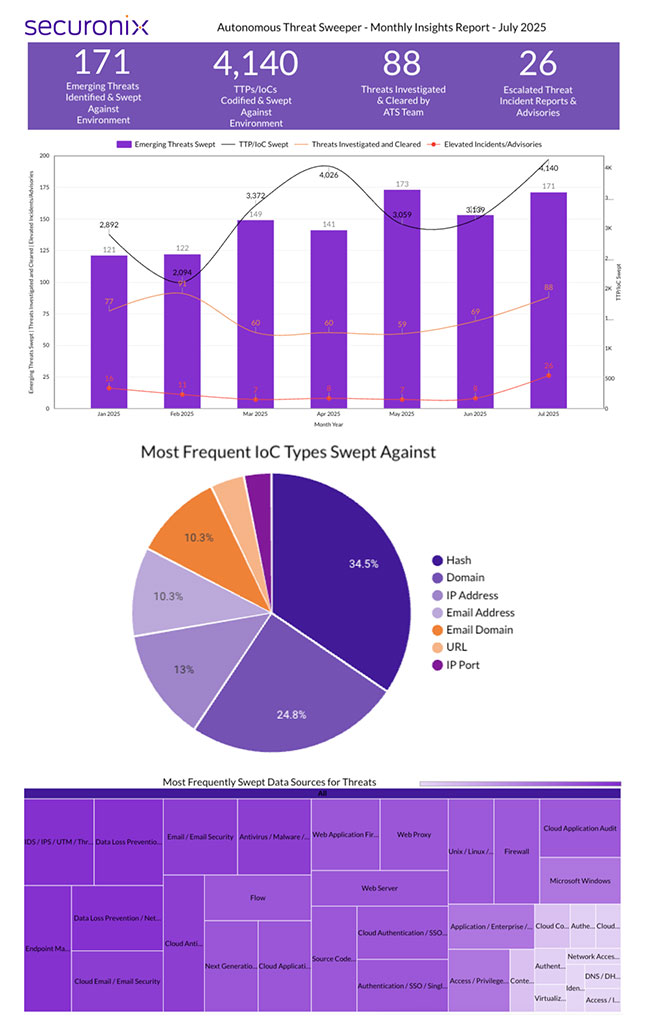
Last month Securonix Autonomous Threat Sweeper identified and analyzed 4,140 TTPs and IoCs, 171 emerging threats, investigated 88 potential threats, and elevated 26 threat incidents. The top data sources swept against include IDS / IPS / UTM / Threat Detection, Data Loss Prevention, Endpoint Management Systems, and Email / Email Security.
In July 2025, the Autonomous Threat Sweeper team identified a cyber threat environment characterized by advanced exploitation techniques, targeted espionage campaigns, and the continued proliferation of ransomware-as-a-service (RaaS) models. ToolShell activity intensified with the simulation and real-world exploitation of CVE-2025-53770 in Microsoft SharePoint, enabling unauthenticated remote code execution (RCE) scenarios. Additional vulnerabilities emerged, such as the Tomcat Partial PUT Camel Header Hijack, which posed stealthy risks to web application integrity. Phishing operations surged, with campaigns like Rainbow Hyena targeting global users, the Taiwan Chip espionage campaign seeking intellectual property, and the DoNot APT conducting spear-phishing against Southern European diplomatic entities. Malware activity expanded as Hpingbot leveraged Pastebin for payload delivery, CL-STA-1020 targeted government bodies, and GhostContainer exploited Microsoft Exchange servers across Asia. Notably, Silver Fox deployed rootkits signed with expired certificates, while Batavia malware campaigns intensified against Russian networks. Ransomware threats reached new heights with variants such as DEVMAN, Pay2Key.I2P targeting Western organizations, Dark 101, KAWA4096, and specialized strains like NailaoLocker Cheese, Interlock leveraging ClickFix-style delivery, and Chaos Ransomware Group attacks. These developments underscore the critical necessity for timely vulnerability patching, heightened phishing awareness, and resilient multi-layered security defenses to counter the evolving threat spectrum.
The ToolShell exploit chain (CVE-2025-49704, CVE-2025-49706, CVE-2025-53770, and CVE-2025-53771) targets on-premises Microsoft SharePoint Servers, allowing unauthenticated remote code execution (RCE).
Microsoft confirmed that attackers chain these CVEs to deploy .aspx webshells like spinstall0.aspx and steal ASP.NET MachineKeys used to sign __VIEWSTATE data
Persistence: Attackers maintain access using extracted cryptographic secrets, bypassing login even after patching.
Microsoft attributed ToolShell exploitation to China-based threat actors:
Securonix Threat Lab simulated the exploit chain to develop real-world detection logic:
Threat Labs summary
Securonix Threat Labs recommends leveraging our findings to deploy defensive measures against this exploitation of SharePoint ToolShell Zero-Day attack.
TTPs related to the SharePoint ToolShell Zero-Day include but are not limited to the following:
for files like spinstall0.aspx, spinstall.aspx, xxx.aspx, 3plx.aspx, debug_dev.js, or info.js is a key post-exploitation behavior.
Tags: Threat Actor: Storm-2603, Linen Typhoon, Violet Typhoon | Target Sector: Government, Healthcare (including hospitals), Education, Manufacturing, Critical Infrastructure, Technology Consulting, Professional Services | Target Location: United States, Iran, Germany, Greece, Ireland, Russia | Target Systems: Microsoft SharePoint Server (on-premises) Versions 2016, 2019, Subscription Edition | Target Platforms: Windows Server (IIS), .NET Framework, ASP.NET | Adversary Location: China | Malware/Tools: spinstall0.aspx webshell, SharpyShell, 4L4MD4R Ransomware (variant of Mauri870), Mimikatz, Impacket Toolkit, PowerShell encoded payloads, debug_dev.js / info.js output files, IIS .dll backdoors, Edge Utility Abuse (gpu-process, crashpad-handler)
| DoNot APT Group – Southern European Government Campaign | In this operation, the DoNot APT group targeted a Ministry of Foreign Affairs via a highly tailored spear-phishing email impersonating a defense attaché, leveraging HTML tricks and a Google Drive link to deliver a password-protected RAR. Once opened, the victim executes notflog.exe, which drops a BAT loader in %TEMP% that creates two scheduled tasks (“PerformTaskMaintain” and “MicorsoftVelocity”) to install a custom LoptikMod DLL backdoor. The malware employs runtime string decryption, selective section packing, dynamic API resolution and anti-VM checks to evade analysis, and communicates with its C2 over AES-encrypted, Base64-wrapped HTTPS to C2 server domain. |
| China-Aligned Espionage Against Taiwan’s Semiconductor Industry | Three distinct clusters (UNK_FistBump, UNK_DropPitch and UNK_SparkyCarp) used themed lures—graduate-student job offers, investment-research collaborations and MiTM phishing kits—to breach semiconductor targets. They delivered payloads via ZIP→LNK→VBS loaders and DLL sideloads in legitimate Java/Cisco binaries (Cobalt Strike Beacon, Voldemort, HealthKick backdoor and raw TCP shells), established persistence through scheduled tasks, and in select cases installed Intel EMA agents. Infrastructure included SoftEther VPN servers with “elliot-alderson” hostnames and overlapping TLS certificates tied to known tooling, with C2 channels spanning GoToMeeting-style beaconing, Google Sheets API, WebSocket-over-TLS and raw TCP. |
| Rainbow Hyena “PhantomRemote” Campaign | The threat actor group “Rainbow Hyena” launched a sophisticated phishing campaign targeting healthcare and IT organizations in Russia. Leveraging compromised email accounts, the attackers distributed deceptive messages containing malicious polyglot ZIP files and LNK shortcuts, which executed embedded DLLs. The campaign introduced a new custom backdoor dubbed PhantomRemote, capable of system reconnaissance, command execution, and file download via HTTP-based C2 communication. This tool masqueraded as legitimate services using fake User-Agent headers and exploited native Windows utilities like rundll32.exe and cmd.exe. The shift in tactics—particularly the use of masquerading techniques and evasion strategies—highlights the group’s evolution from hacktivist motives toward more structured espionage and financial objectives. |
Threat Labs summary
Securonix Threat Labs recommends leveraging our findings to deploy defensive measures against these phishing campaigns.
TTPs related to the DoNot APT Group include but are not limited to the following:
TTPs related to the China-Aligned Espionage Actors include but are not limited to the following:
TTPs related to the Rainbow Hyena “PhantomRemote” include but are not limited to the following:
Tags: Threat Actor: DoNot APT Group, China-aligned clusters (UNK_FistBump, UNK_DropPitch, UNK_SparkyCarp), ainbow Hyena hacktivist cluster | Target Sector: Government / Diplomatic (Ministry of Foreign Affairs), Semiconductor manufacturing / Technology, Varied industries (logistics, corporate) | Target Location: Southern Europe, Taiwan, Global | Target Systems: Windows endpoints, Windows workstations/servers in semiconductor environments | Target Platforms: Microsoft Windows
| DEVMan Ransome | A newly observed ransomware strain named DEVMan builds upon the DragonForce codebase but introduces its own distinct features. It appends a [.]DEVMan extension to encrypted files and uses static, deterministic ransom notes in each attack. While operating offline by default, it has limited capability to propagate across the network via SMB. Before encrypting data, DEVMan avoids backup files and shadow copies to maximize impact. It supports three encryption modes—comprehensive full‑file encryption, a faster header‑only option, or a custom stealth mode designed to balance speed and effectiveness. Additionally, DEVMAN leverages the Windows Restart Manager to unlock the files and stores session metadata in the Windows registry to maintain operational state. |
| KAWA4096 Ransomware | KAWA4096 is a newly identified ransomware strain that surfaced in June 2025, primarily targeting organizations in the United States and Japan with at least 11 known victims so far. KAWA4096’s ransom note closely mimics with Qilin ransomware, while its leak site emulates Akira’s ransomware. It employs multi-threaded execution to accelerate file encryption and extend its impact across shared network drives. Upon execution, the ransomware re-launches itself with the whole parameter to ensure full functionality, creates a mutex to enforce single-instance execution, and terminates predefined processes and services. KAWA4096 deletes shadow copies using Windows Management Instrumentation. Post-encryption, it modifies the victim’s desktop wallpaper to a plain black screen and alters the icons of encrypted files to resemble those of the SQL Monitor application. |
| Dark 101 Ransomware | The Dark 101 ransomware represents a sophisticated evolution in ransomware landscape, leveraging an obfuscated .NET binary to execute a multi-stage attack that maximizes system disruption and maintaining persistence. It begins with environmental reconnaissance to evade sandboxing, copies itself into the %AppData% directory as svchost.exe, and disables recovery options by deleting Volume Shadow Copies and the Windows Backup catalog. It modifies the registry setting to disable Task Manager. Encrypted files are appended with randomly generated four-character extensions, and ransom notes titled read_it.txt, demanding ransom in Bitcoin for decryption. |
| NailaoLocker Ransomware | A newly identified Windows ransomware variant named NailaoLocker, employs a stealthy technique by embedding its malicious payload within a legitimate diagnostic tool, usysdiag.exe to evade detection. NailaoLocker executes its payload directly in memory to reduce its forensic footprint. It avoids critical directories such as Windows and Program Files while scanning and selectively targets user’s sensitive data for encryption using AES-256 in CBC mode, appending a [.]locked extension to each encrypted file. NailaoLocker drops a plain text ransom note in every affected directory, demand payment in cryptocurrency in exchange of decryption key. Notably, the ransomware embeds a hardcoded SM2 elliptic curve key pair and includes an undocumented cheese password that trigger an internal recovery feature. |
| Interlock Ransomware | A joint advisory has been issued on financially motivated ransomware operation named Interlock ransomware, targeting businesses and critical infrastructure in North America and Europe. The group employs drive-by downloads from compromised websites and ClickFix social engineering lure to deliver payloads, deploying PowerShell based RAT that maintain persistence through the Windows Startup folder or registry modifications. Interlock operators exfiltrate system information and credentials using custom stealers and keyloggers, and enable lateral movement using RDP, AnyDesk, and PuTTY. Notably, they encrypt virtual machines (Windows and Linux) using hybrid AES-RSA scheme and appending filenames with [.]interlock or [.]1nt3rlock. Victims receive a !README!.txt ransom note via Group Policy, instructing them to contact over Tor for payment and data recovery instructions. |
| Chaos RaaS Group | A newly emerged RaaS group called Chaos has been active since February 2025. It initiates attacks through voice-based social engineering and phishing tactics to deploy RMM tools such as AnyDesk and ScreenConnect, establishing persistent access across compromised networks. Chaos employs advanced methods to encrypt local and remote files, appending [.]chaos extension and deleting shadow copies to prevent recovery. The group mainly targets organizations in the technology, manufacturing, and professional services sectors, especially in the U.S. and several other regions, threatening to leak stolen data or launch DDoS attacks. |
| Pay2Key RaaS | The Iranian-backed Pay2Key RaaS operation resurfaced with a renewed focus on targeting Western organizations and critical infrastructure. This group operates under the name Pay2Key.I2P and is linked to the Fox Kitten APT group, allowing affiliates to retain up to 80% of ransom payments. The operation has expanded to support Linux-compatible payloads alongside its existing Windows variants. Attacks are deployed via self-extracting 7-Zip archives that run dual CMD/PowerShell scripts, stealthily disabling Windows Defender and unpacking encrypted components. Additionally, the operators have publicly shared evidence of payouts, victim identifiers, and antivirus bypass demonstrations. |
| Global Group RaaS | The emergence of a new RaaS group called GLOBAL GROUP, promoted on the Ramp4u underground forum by a Russian-speaking actor known as $$$. It is believed to be rebranding of the BlackLock RaaS operation, offering its affiliates 85% revenue share and operates a Tor-hosted leak site for publishing exfiltrated data. GLOBAL GROUP significantly made headlines by compromising 17 victims across various sectors such as healthcare, manufacturing and business services in the United States, United Kingdom, Australia, and Brazil. They rely on Initial Access Brokers to infiltrate networks and employ brute-force tools against Microsoft Outlook and RDWeb portals. Notably, the group leverages AI-driven chatbots to handle ransom negotiation and can impact both Windows and Linux environments, including virtual machine deployments. |
Threat Labs summary
TTPs related to the DEVMan Ransomware group include but are not limited to the following:
TTPs related to the KAWA4096 Ransomware include but are not limited to the following:
TTPs related to the Dark 101 ransomware include but are not limited to the following:
TTPs related to the NailaoLocker Ransomware include but are not limited to the following:
TTPs related to the Interlock Ransomware include but are not limited to the following:
TTPs related to the Chaos RaaS include but are not limited to the following:
Tags: Ransomware Group: DEVMan Ransomware, KAWA4096 Ransomware, Dark 101 ransomware, NailaoLocker Ransomware, Interlock ransomware, Chaos RaaS, Pay2Key RaaS, GLOBAL GROUP | Target Locations: United States and Japan, North America, Europe, United Kingdom, Australia, and Brazil| Target Sectors: Healthcare, manufacturing, business services, critical infrastructure, technology, manufacturing, and professional services.
| Batavia Spyware Steals Data from Russian Organizations | A targeted spyware campaign dubbed Batavia emerged, focusing on Russian industrial enterprises. Delivered via spear-phishing emails disguised as contract-related communications, the attack unfolds in three stages: a malicious VBS downloader script, a Delphi-based WebView.exe module, and a C++-based javav.exe module. Together, these components collect and exfiltrate sensitive files—including office documents, system logs, screenshots, and additional file types—while employing techniques to avoid duplicate transfers. The malware also supports downloading extra payloads, changing C2 servers, and using UAC bypass methods for persistence. By June 2025, over 100 users across several dozen organizations had been targeted. |
| New Progress of “Silver Fox” | A new variant of the “Silver Fox” remote-control trojan, which employs multiple rootkit drivers, InfinityHook kernel hooking, and kernel read/write penetration to evade detection and disable security software. Distributed via counterfeit software download pages, the malware uses leaked and expired driver signatures to load malicious drivers, hide processes and network activity, and terminate antivirus processes. It achieves persistence through concealed scheduled tasks, executes a “WinOS” remote control module for long-term control and data theft, and leverages open-source projects for stealth. |
| GhostContainer Backdoor for Exchange Servers | A new malware discovered “GhostContainer” (aka NightEagle), a highly modular .NET backdoor targeting Exchange servers—likely via CVE-2020-0688. The attackers deploy a malicious App_Web_Container_1.dll into the Exchange web root, which launches a Stub class that bypasses AMSI, leverages ASP.NET machine keys for AES-encrypted communications, and supports shellcode execution, file operations, and dynamic .NET module loading. A “virtual page injector” class creates ghost ASPX endpoints on demand, while a custom web-proxy/tunneling class (based on Neo-reGeorg) enables HTTP(s) proxying and TCP tunnels entirely over normal Exchange requests—leaving no external C2 artifacts. Two high-value targets (a government agency and a tech firm) in Asia have been identified. |
| HazyBeacon’s Novel Covert C2 via AWS Lambda URLs | HazyBeacon, an undocumented Windows backdoor that achieves persistence through DLL sideloading of mscorsvc.dll alongside the legitimate mscorsvw.exe service. Upon service start, the malicious DLL beacons to an AWS Lambda URL endpoint—hiding C2 traffic within legitimate amazonaws.com requests. The actor then issues commands to run arbitrary payloads and to exfiltrate collected data via Google Drive and Dropbox clients installed under C:\ProgramData. Persistence is ensured by creating a “msdnetsvc” Windows service. |
| Hpingbot: A New Pastebin-Driven Botnet with hping3 DDoS Module | Hpingbot, first seen June 2025, is a Go-based cross-platform botnet (Windows/Linux/IoT) that uses Pastebin to host payload URLs and hping3 as its DDoS engine. While DDoS activity (mostly against Germany, the U.S, and Turkey) has been sporadic, its core value lies in a generic payload-download-and-execute capability: embedded Pastebin links point to download scripts (payload.sh) with German comments that self-update by architecture, install via curl/wget, and establish persistence through Systemd, SysVinit, and cron. The botnet’s commands (e.g., SYN, ACK floods) map directly to hping3 parameters, and its rapid iteration—frequent C&C rotations and script revisions—suggests a professional team behind it. |
Threat Labs summary
Securonix Threat Labs recommends leveraging our findings to deploy defensive measures against these malicious campaigns.
TTPs related to the Batavia spyware include but are not limited to the following:
TTPs related to the new progress of “Silver Fox” include but are not limited to the following:
TTPs related to the GhostContainer backdoor include but are not limited to the following:
TTPs related to the HazyBeacon’s Novel include but are not limited to the following:
TTPs related to the Hpingbot include but are not limited to the following:
Tags: Threat Actor: Batavia, Silver Fox operators, GhostContainer (aka NightEagle), HazyBeacon operators, Hpingbot operators | Target Sector: Russian enterprises & critical infrastructure, Software development / IT infrastructure, Government, Enterprise, Telecom, Finance | Target Location: Russia, Global, Asia, Southeast Asia, Germany, U.S, Turkey | Target Systems: Windows endpoints, Windows OS (kernel‐level), Microsoft Exchange servers, Windows services, IoT devices, Windows, Linux.
A critical flaw in Apache Tomcat’s “partial PUT” handler tracked as CVE-2025-24813 has become one of the loudest security stories this July. The bug lets an attacker upload a rogue .session file via a PUT request that includes a crafted Content-Range header; when Tomcat later restores that session, it deserializes the object and executes arbitrary code with the server’s privileges. Every active Tomcat branch (9.0, 10.1 and 11.0) is affected, and opportunistic scanners have already generated well over 125 thousand probes from more than 70 countries, proving how quickly the exploit has entered commodity toolchains.
The attack is a two-step affair: first, the adversary issues PUT /<rand>.session with a Content-Range: bytes 0-452/457 header to plant the payload; seconds later they send any request bearing Cookie: JSESSIONID=.<rand>, which tricks Tomcat into loading and running the malicious session file. Successful exploitation hinges on common default settings (readonly=”false” and persistent sessions), making internet exposed servers easy targets. Most live attempts reuse the same six-character filenames and header values found in the public Nuclei template, a clear sign that scripted mass scanning is driving the campaign.
Applying the newly released Tomcat patches (or upgrading to the fixed builds) is the definitive fix; short of that, re enable readonly, disable partial PUT if it’s not a business requirement, and watch for the unmistakable .session uploads coupled with the Content-Range header. Network defenders running Palo Alto NGFWs can also block traffic with Threat-Prevention signature 96315 while patching rolls out.
Threat Labs summary
Securonix Threat Labs Recommends leveraging these findings to strengthen defenses against these malware campaigns.
TTPs related to the Tomcat Partial PUT Deserialization include but are not limited to the following:
Tags: Target System: Apache Tomcat | CVE Exploited: CVE-2025-24813, CVE-2025-27636, CVE-2025-29891 | Target Location: Global | Payload: Reverse shells, DNS/OAST beacons |Tactic: Remote Code Execution
For a full list of the search queries used on Autonomous Threat Sweeper for the threats detailed above, refer to our Threat Labs home page. The page also references a list of relevant policies used by threat actors.
We would like to hear from you. Please reach out to us at [email protected].
Note: The TTPs when used in silo are prone to false positives and noise and should ideally be combined with other indicators mentioned.
Contributors: Dheeraj Kumar, and Sina Chehreghani