The Art of Detection Engineering: Why Great Detections Are Built with You
AI and Cybersecurity, Detection Engineering



Why Great Detections Are Built with You
Abhishek Narasimhan, Sachin A B
TL;DR: Out-of-the-box detection content gives security teams a strong starting point from day one. Its full value emerges when that content is tuned to reflect the users, systems, workflows, and risks unique to your environment. This article walks through why tuning matters, how mature security teams approach it, and how Securonix helps turn expert-built detection content into high-fidelity security outcomes.
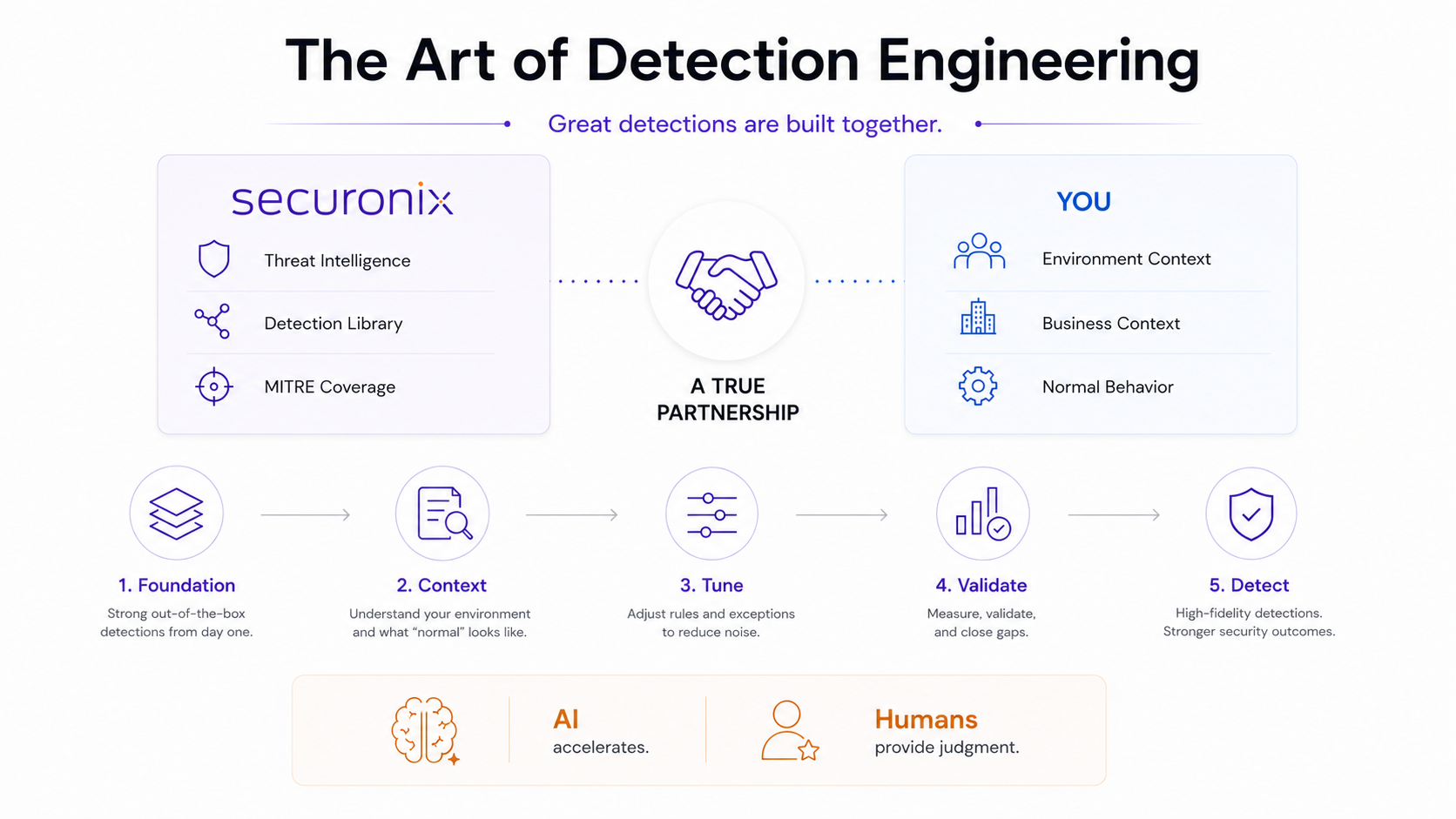
People tend to picture detection engineering as an install job. Stand up the tool, switch on the rules, and wait for the alerts to roll in. But anyone who has spent time in Security Operations Center knows it doesn’t always pan out in the way you expect. Detection is closer to a craft than a configuration. And the most effective security programs are the ones that treat detection not as a switch to flip, but as a partnership to cultivate. That partnership begins with a strong foundation. It reaches its full potential through tuning.
That growth starts with a solid foundation, and it pays off when you tune.
Which brings me to something I see misunderstood more than almost anything else in this field: how organizations think about the detection content that ships with their tools.
When you turn on Securonix, you’re inheriting a lot of expert work. Our threat researchers and detection engineers have built thousands of curated detections and behavior analytics, mapped against MITRE ATT&CK. That’s not a small thing. It’s coverage across the known threat landscape that would take an in-house team years to assemble.
This content is meant to protect you on day one, and it does. It carries the collective intelligence of a global customer base and a constantly updated read on how attackers are operating right now. It’s genuinely powerful.
But the real value comes when that foundation is adapted to your environment. Mature teams know that the strongest detections combine broad threat intelligence with the local context needed to distinguish expected activity from risk.
No two environments produce the same “normal.” Log sources differ; naming conventions vary, and what counts as ordinary on a Monday afternoon in Finance looks nothing like ordinary on a shop floor. That local context is what turns a decent, general-purpose detection into something an analyst can trust.
Take a detection most SOC teams know well: Suspicious process spawned from MS Office applications. It looks like a clean win the day you turn it on. Then the first alert comes in from Finance, where an approved document-generation tool kicks off PowerShell every month as part of standard reporting. A few days later, another alert traces back to an engineering team’s deployment script. At that point the question isn’t whether the detection works: i Environmental context is what separates expected behavior from activity that deserves investigation.
We see this same rule land three different ways in three different environments. At a financial firm where Office automation drives the reporting cycle, that PowerShell-from-Office pattern appears constantly and legitimately, so the detection needs tuning that excludes the routine and leaves only signal. Drop that same rule into a manufacturing company that has never once triggered it on purpose, and every hit becomes a finding worth chasing immediately. Put it in a software company where one internal tool trips it a couple of times a day, and the right move is a narrow, targeted exception, not a broad suppression that blinds the rule to everything else.
Same detection. Same underlying attacker behavior. Three different right answers, because the environment has changed, not the logic. That gap between the behavior an attacker exhibits everywhere and what’s normal inside your specific walls, is where detection engineering stops being mechanical and becomes judgment. Threat behavior travels. Normal stays local. Tuning is how you close the distance.
Tuning is a natural part of detection engineering. As teams learn more about their environment, they can refine detections to account for legitimate behavior, reduce noise, and focus analyst attention on activity that matters.
For teams beginning that process, a few principles are worth keeping in mind:
You can’t write high-fidelity detections until you understand what legitimate activity looks like in your environment. Which service accounts fire off scheduled tasks? Which admins actually use remote PowerShell, and when? Almost every good tuning decision traces back to answering questions like these.
When you suppress benign activity, you’re documenting how your environment works. Write it down and explain the reasoning. Over time those notes make the whole program smarter and a lot easier to hand to the next analyst.
You can measure detection quality. True-positive rates, how much load you’re putting on your analysts, where your coverage has gaps. Keep refining against those and good detection turns into great detection.
As detection programs mature, teams increasingly manage detection content with the same discipline engineering teams apply to software. Put your detection changes under version control with notes so nothing is a mystery. Test new detections against known attack samples and clean baseline data before they ever hit production. Review rule changes with the same seriousness you’d give a pull request. Do that, and tuning stops being a pile of one-off tweaks nobody remembers making. It becomes a repeatable, auditable process, and your detection library turns into an asset that improves with age.
The vendor-customer relationship is at its best when it’s collaborative. Securonix brings threat research, intelligence, detection expertise, and the platform. Customers bring the context only they can provide, including how their environment operates, where their risks lie, and what matters most to the business. Put those together and you get something neither side could produce on its own: detection that’s broad in coverage and precisely fitted to your environment.
We are our own customer zero. Before detection content reaches customers, Securonix Threat Labs validates it in our own environment, bringing real-world operational insight into how that content is developed and refined.
That gives customers a strong starting point, while leaving room to adapt detections to their own users, systems, workflows, and risks. Securonix supports that process with ongoing threat research, evolving detection content, and expertise that helps teams improve fidelity as their environments change.
AI is speeding up how detections get written and tuned, and make the fundamentals matter more, not less. That’s exactly where innovations like the Securonix Policy Agent come in. By helping security teams rapidly draft detection logic from blogs, and build threat use cases, it accelerates the engineering process and gives analysts a stronger starting point. The decision on whether a detection fits your environment is still a human one, guided by people who understand your business, your risks, and what “normal” looks like.
The tools will continue to get faster and more capable, but high-fidelity detection still depends on the right combination of threat intelligence, AI-assisted engineering, and environmental context.
Detection engineering is ultimately a translation process. It takes common attacker behaviors and adapts them to the realities of a specific environment. Securonix provides the foundation with expert-built detection content, while capabilities like Policy Agent help accelerate how that content is created, tested, and refined.
The strongest detections come from combining that foundation with the operational knowledge of the teams who understand the environment best. As threats evolve and environments change, that collaboration helps detection stay precise, relevant, and effective.