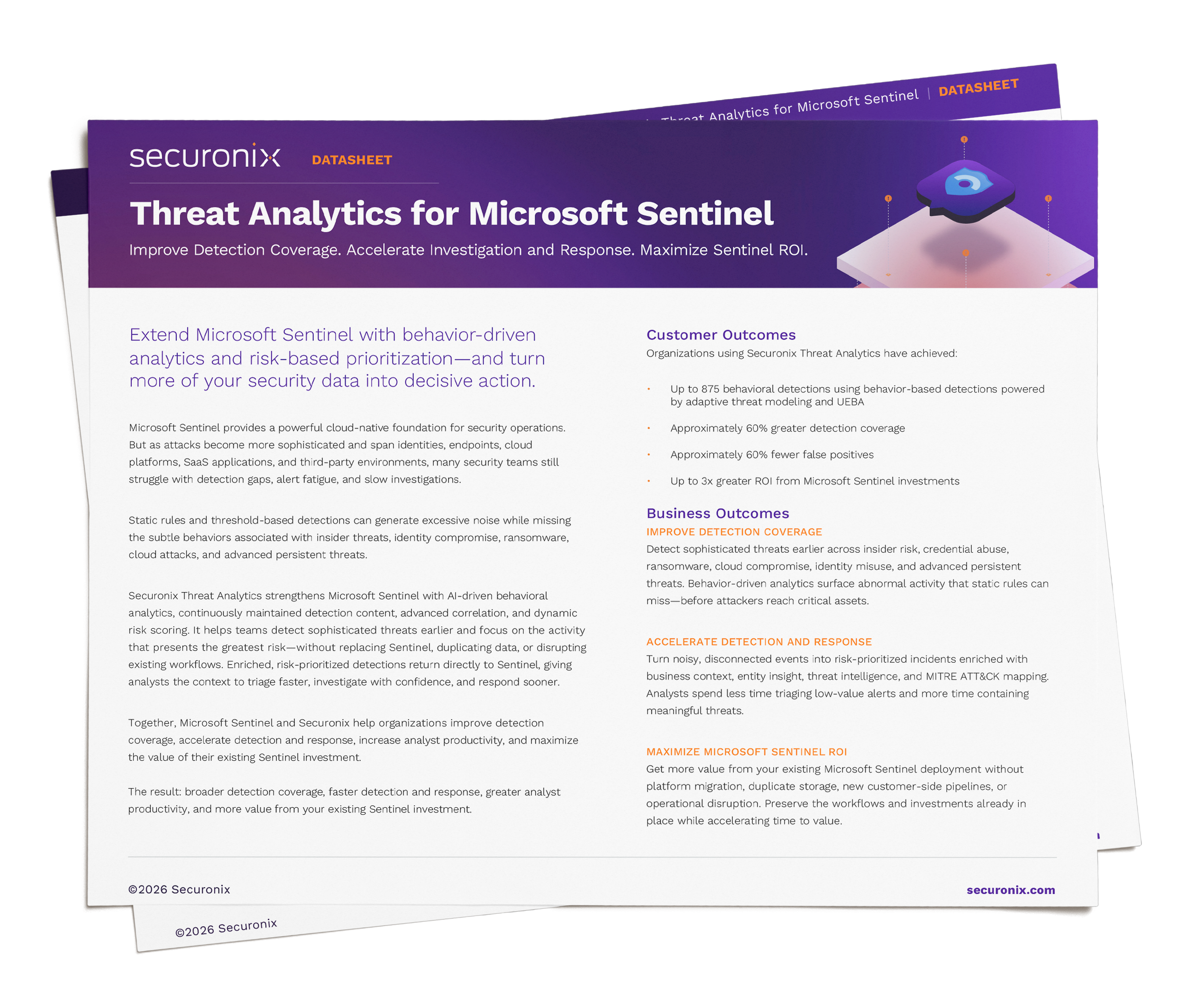
Threat Analytics for Microsoft Sentinel
Turn Microsoft Sentinel Into a High-Fidelity Detection Platform. Improve Detection Coverage. Accelerate Detection and Response. Maximize Sentinel ROI.



Turn Microsoft Sentinel Into a High-Fidelity Detection Platform. Improve Detection Coverage. Accelerate Detection and Response. Maximize Sentinel ROI.
Securonix Threat Analytics enhances Microsoft Sentinel with advanced behavioral analytics, threat detection, risk prioritization, and investigation capabilities, without disrupting existing Sentinel workflows.
Extend Microsoft Sentinel with behavior-driven analytics, risk-based prioritization, and continuously maintained detection content—while Sentinel remains the system of record and primary analyst workflow.
See how Securonix enriches, correlates, and prioritizes Sentinel telemetry—without replacing the platform your SOC already uses.
Microsoft Sentinel provides a strong cloud-native foundation for telemetry collection, investigation, and response. But as data volumes grow, detection quality depends on more than rules and thresholds. Sophisticated attacks often unfold across identity, endpoint, cloud, SaaS, and third-party tools. Securonix strengthens Microsoft Sentinel with behavioral analytics, cross-source correlation, entity context, and risk-based prioritization to help teams reduce alert noise and detect threats earlier.
The problem is the effort required to turn data into meaningful, risk-prioritized detection outcomes.
Securonix Threat Analytics strengthens Microsoft Sentinel with behavior-driven detection, advanced correlation, entity context, and dynamic risk scoring.
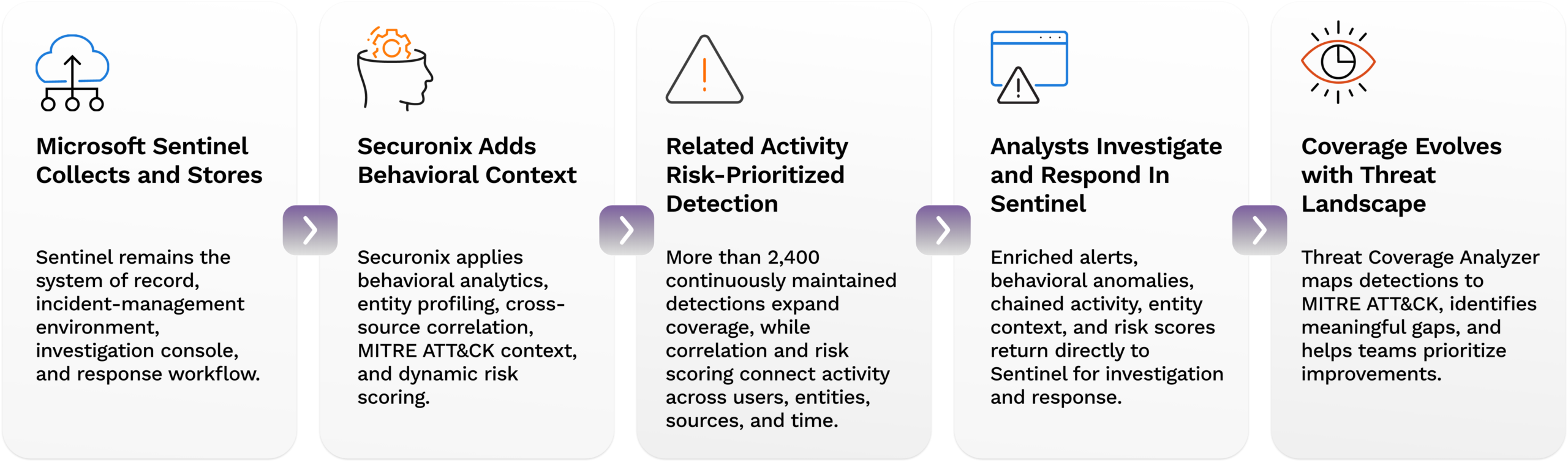
It applies UEBA, anomaly detection, entity profiling, and 2,400+ Threat Labs-backed detections to the telemetry customers already collect. Sentinel remains the system for telemetry, incidents, and response, while Securonix enriches and prioritizes detections before sending higher-confidence findings back to Sentinel.
Analysts continue working in Sentinel with clearer evidence, stronger risk context, and no SIEM migration, data duplication, agents, new customer-side pipelines, or disconnected workflows.
Broader Coverage. Faster Triage. More Confident Response.

Connect related activity across users, entities, sources, and time to replace fragmented alerts with enriched, risk-prioritized incidents.

Identify subtle and multi-stage threats across identity, insider risk, ransomware, cloud, SaaS, endpoint, and third-party environments using behavior-driven analytics and cross-source correlation.

Operationalize more than 2,400 maintained detections while reducing custom KQL development, threshold tuning, testing, validation, and ongoing content maintenance.

Increase the fidelity, context, and prioritization of the detections analysts receive while keeping Sentinel at the center of security operations.

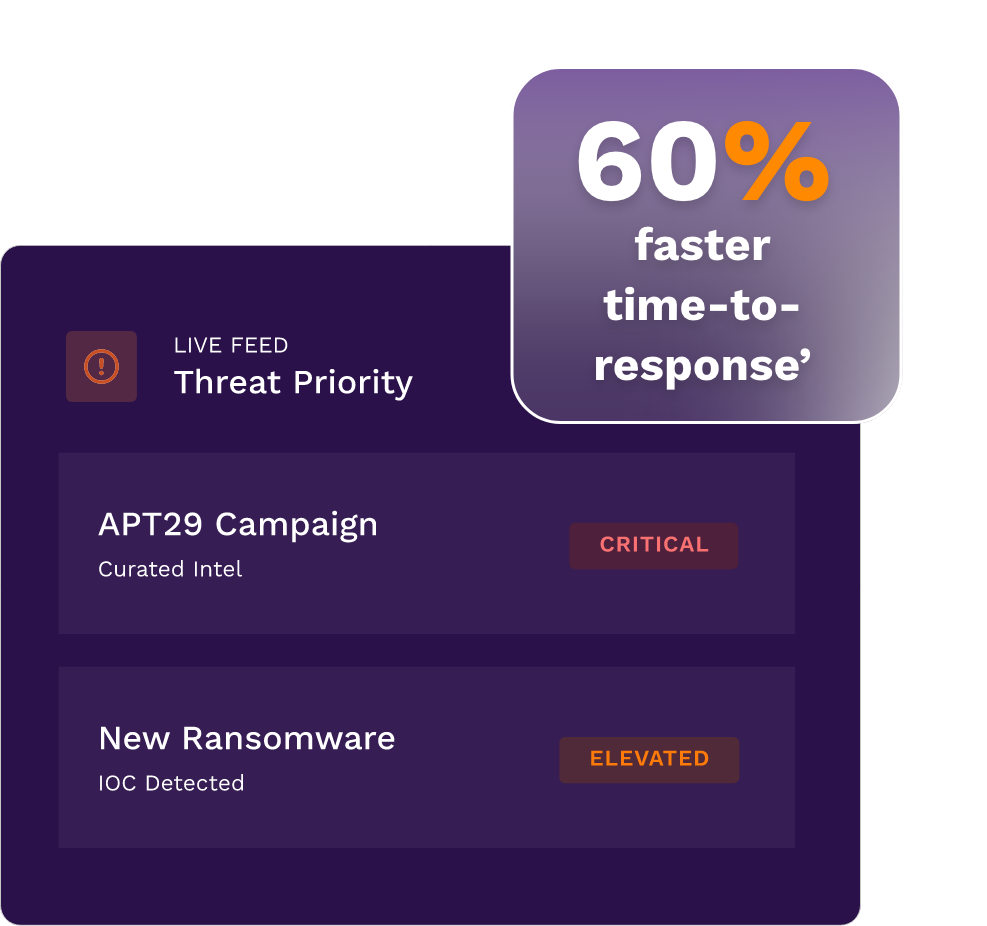
Give analysts behavioral evidence, entity context, threat intelligence, MITRE ATT&CK mapping, and risk scores at the start of an investigation—so they can move from alert to informed action faster.

Expand detection across AWS, Google Cloud, SaaS platforms, identity providers, endpoints, and third-party security tools with 600+ integrations that help unify analytics across heterogeneous environments.
Securonix Threat Analytics helps MSSPs and MDR providers standardize behavior-driven detection across customer Sentinel environments. Providers can improve coverage, reduce tuning, and deliver more consistent managed detection without replacing Sentinel or disrupting analyst workflows.
With behavioral detection, UEBA, insider risk, and coverage analysis, providers can create premium managed detection services while protecting service margins and extending visibility across Microsoft and non-Microsoft identity, cloud, SaaS, endpoint, and security telemetry.
Deliver better detection. Preserve every customer’s Sentinel workflow.

Securonix Threat Analytics enriches Microsoft Sentinel telemetry with behavior-driven analytics, entity context, advanced correlation, and continuously maintained detection content. Teams gain deeper detection coverage and clearer investigation context while Sentinel remains the system of record, investigation console, and response workflow.
Securonix helps teams detect unusual activity across users, identities, accounts, devices, workloads, and peer groups, even when static rules miss the signal. With 2,400+ Threat Labs-backed detections, risk-based prioritization, and context across Microsoft and non-Microsoft telemetry, analysts can focus on the activity most likely to create business impact.
Capability | Securonix Threat Analytics | Native Sentinel | Point Tools or Custom Pipelines |
|---|---|---|---|
Real-time Detection | Unlimited real-time detections beyond Sentinel’s 50 NRT rule limit | Constrained by native NRT rule limits | Varies by tool or custom build |
Maintained Content | 2,400+ continuously maintained Threat Labs-backed detections | Customer-built, Microsoft-native, or manually tuned content | Often requires ongoing engineering and maintenance |
Analytics Depth | Behavioral analytics, UEBA, anomaly detection, correlation, and risk scoring | Primarily rule-based and threshold-driven logic | Varies by tool or custom implementation |
Cross-source Context | Industry-leading UEBA across users, entities, identities, and workloads | Limited native behavioral detection depth | Often siloed or narrow in scope |
Architecture Impact | No duplication, no re-ingestion, no added storage | Native ingestion model | Often duplicates data or requires new pipelines |
Ecosystem Coverage | 2,400+ detections, MITRE-aligned coverage analysis and 600+ integrations | Strong Microsoft-native visibility | Fragmented across tools and ecosystems |
Operational Model | Lightweight deployment with no migration or replacement | Requires ongoing tuning and engineering | High maintenance and engineering overhead |
Workflow | Alerts, anomalies, and detections returned to Sentinel | Native Sentinel workflows | Often creates workflow fragmentation |
System of record | Sentinel remains the data lake, investigation console, and response workflow | Sentinel-native | May shift analysts into other tools |
The metrics presented are based on a single customer implementation and are provided for illustrative purposes only. Actual customer results will vary depending on deployment scope, customer environment, available telemetry, data quality, configuration, use cases, and operational maturity. These metrics are not guarantees of results or performance and should not be interpreted as representative of typical customer outcomes.
Identify anomalous user behavior, privilege misuse, risky peer-group deviations, and potential data exfiltration before sensitive information is compromised.
Detect credential abuse, account compromise, impossible travel, suspicious authentication behavior, and lateral movement across hybrid identity environments.
Uncover early-stage ransomware behaviors, privilege escalation, lateral movement, command-and-control activity, and multi-stage attack patterns before business disruption occurs.
Go beyond Sentinel’s 50 NRT rule limit with unlimited real-time detections that expand coverage without requiring custom rule engineering.
Monitor activity across Microsoft Azure, AWS, Google Cloud, SaaS applications, endpoints, and identity providers for suspicious behavior beyond Microsoft-native telemetry.
Reduce analyst workload by turning noisy alerts into enriched, risk-prioritized incidents that support faster triage and response.
Use MITRE-aligned coverage analysis to understand where Sentinel detection coverage is strong, where gaps remain, and where to improve next.
Attackers move across identities, clouds, SaaS applications, endpoints, and third-party environments—often using valid credentials and activity that appears normal in isolation. Static rules and fragmented alerts make these attacks difficult to detect and slow to investigate.
Securonix Threat Analytics connects the activity into a broader attack story. Teams improve detection coverage, accelerate detection and response, and maximize Sentinel ROI while preserving existing data, workflows, playbooks, and platform investments.

See how Securonix Threat Analytics can improve detection coverage, accelerate detection and response, and maximize Sentinel ROI without replacing Sentinel or changing how your analysts work.