Your Microsoft Sentinel Has the Data. Does It Have the Detection Depth?
Agentic, AI and Cybersecurity



Beth Dannemiller, Senior Director, Product Marketing, Securonix
Beth Dannemiller, Senior Director, Product Marketing
Microsoft Sentinel gives security teams a strong cloud-native foundation for collecting telemetry, investigating incidents, and orchestrating response.
But collecting more security data does not automatically produce better detection outcomes.
As environments expand across identities, endpoints, cloud infrastructure, SaaS applications, networks, and third-party platforms, SOC teams must distinguish meaningful risk from an overwhelming volume of routine activity. The most damaging attacks often do not generate one obvious, high-severity alert. They develop gradually through valid credentials, trusted tools, permitted access, and low-volume actions that appear normal when viewed separately.
The challenge is not a lack of data.
It is the operational effort required to turn that data into high-confidence, risk-prioritized detections.
Static rules and thresholds remain an important part of a Microsoft Sentinel detection strategy. They are effective when teams know the condition they need to identify and can define it precisely.
Modern attacks, however, do not always follow predictable patterns.
Consider an attacker who compromises a legitimate account, performs reconnaissance over several days, changes privileges, accesses unfamiliar systems, and slowly moves toward sensitive data. No single action may exceed a threshold. Each event may appear routine in isolation.
Detecting the full attack often requires teams to:
This work can consume significant detection-engineering capacity. It also becomes harder to sustain as the environment, threat landscape, and volume of security telemetry continue to grow.
Security teams need a way to strengthen Sentinel detection without building every analytic from scratch.
Securonix Threat Analytics extends Microsoft Sentinel with a lightweight, cloud-native analytics and enrichment layer.
It applies industry-leading user and entity behavior analytics, advanced correlation, continuously maintained Threat Labs content, curated threat intelligence, entity context, and dynamic risk scoring to telemetry already collected by Sentinel.
This behavior-driven approach evaluates how users and entities typically operate, identifies meaningful deviations, and connects related activity across sources and time. Instead of evaluating every event against the same fixed threshold, Securonix considers whether the activity is unusual for that user, device, identity, account, or workload and whether additional signals increase its risk.
The resulting high-confidence detections are returned directly to Microsoft Sentinel for investigation and response.
Sentinel remains the system of record, primary investigation console, and operational workflow.
Sentinel collects and orchestrates. Securonix enriches, correlates, and prioritizes. Analysts investigate and respond in Sentinel.
An identity may be compromised in one environment, used to change privileges in another, and leveraged to access sensitive data through a third. Platform-specific alerts may identify individual actions without revealing the coordinated attack path.
Securonix helps extend behavioral visibility across Microsoft and non-Microsoft telemetry, including identity, cloud, SaaS, endpoint, network, application, and third-party security data.
More than 2,400 continuously maintained Threat Labs-backed detections help organizations address high-value use cases such as:
Threat Coverage Analyzer maps detections to MITRE ATT&CK, identifies meaningful gaps, and helps teams prioritize improvements. ThreatWatch evaluates historical telemetry against emerging indicators and attacker techniques, helping uncover activity that may not have been recognizable when it first occurred.
With support for more than 600 integrations, Securonix can also correlate activity across heterogeneous hybrid and multi-cloud environments.
The goal is not simply to generate more alerts. It is to identify sophisticated threats earlier and with greater confidence.
Detection engineering involves far more than writing an initial query.
Every analytic must be designed, tested, tuned, validated, documented, mapped, updated, and maintained. Custom correlation and enrichment pipelines require ongoing operational support. Static thresholds must be adjusted as user behavior and business environments change.
Securonix reduces this workload through:
These capabilities reduce the need to manually engineer every detection use case or continuously maintain one-size-fits-all thresholds.
They also improve the analyst experience.
Instead of receiving disconnected, low-fidelity alerts, analysts receive enriched incidents that include behavioral context, related activity, threat intelligence, entity information, ATT&CK mapping, and risk scores at the beginning of the investigation.
That means less time maintaining detections and gathering context, and more time investigating and responding to meaningful threats.
Improving detection should not require replacing Microsoft Sentinel or forcing analysts into a separate operating model.
Securonix is designed to strengthen the Sentinel-centered SOC:
Organizations improve the value of the telemetry they already collect while preserving their Microsoft architecture, workflows, processes, and investments.
Depending on the environment, use cases, and deployment scope, potential or observed results may include approximately 60% greater detection coverage, approximately 40% fewer false positives, up to 85% faster deployment, and up to 3x greater Sentinel ROI. Supported environments may begin realizing value in approximately two to three weeks, although actual outcomes and timelines vary.
Microsoft Sentinel provides the foundation for collecting telemetry, managing incidents, and orchestrating response.
Securonix makes the detections stronger.
By adding behavior-driven analytics, continuously maintained content, advanced correlation, curated threat intelligence, entity context, and risk-based prioritization, security teams can improve detection coverage without increasing the engineering burden or disrupting established operations.
The result is a stronger Sentinel-centered security operation:
How does this approach work against real-world threats?
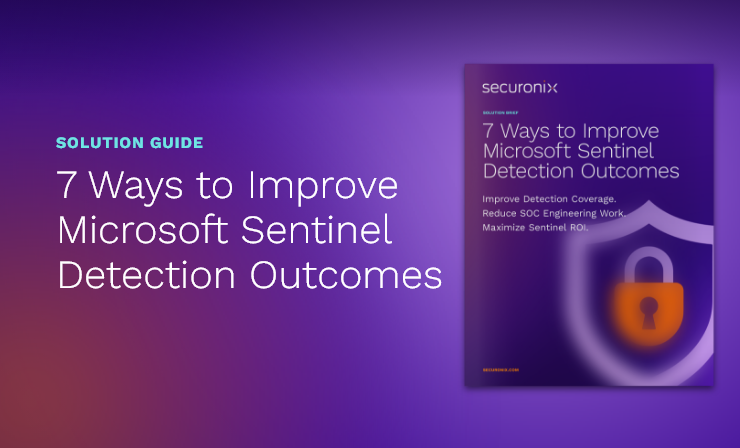
The solution guide, “7 Ways to Improve Microsoft Sentinel Detection Outcomes,” explores practical use cases including insider risk, credential abuse, ransomware precursors, multi-stage attacks, command-and-control activity, cloud compromise, and automated investigation enrichment.
It also explains how Securonix helps reduce SOC engineering work while keeping Sentinel at the center of investigation and response.
Read the solution guide to see what your current detections may be missing and how to start improving detection outcomes in weeks, not months.